
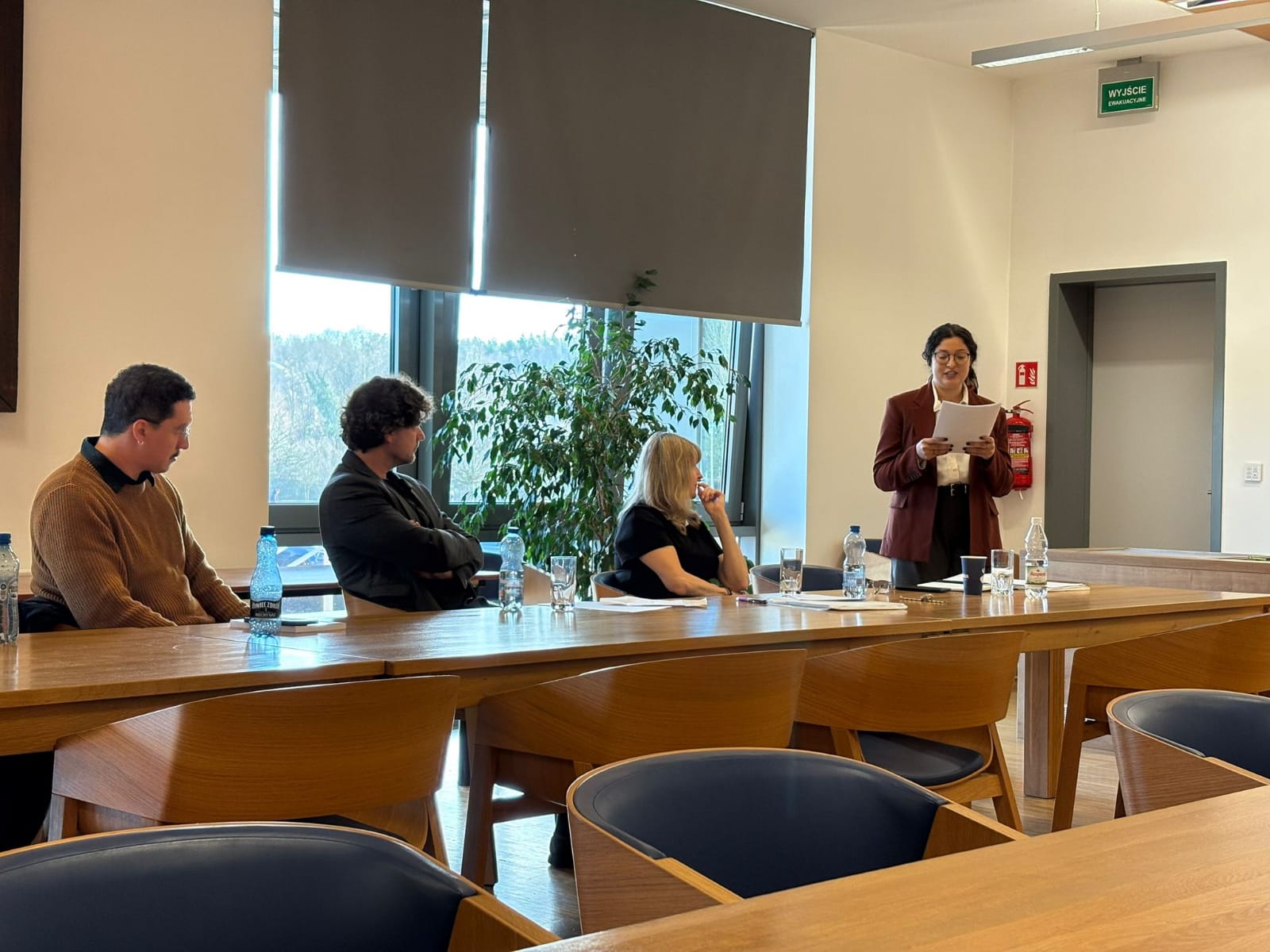
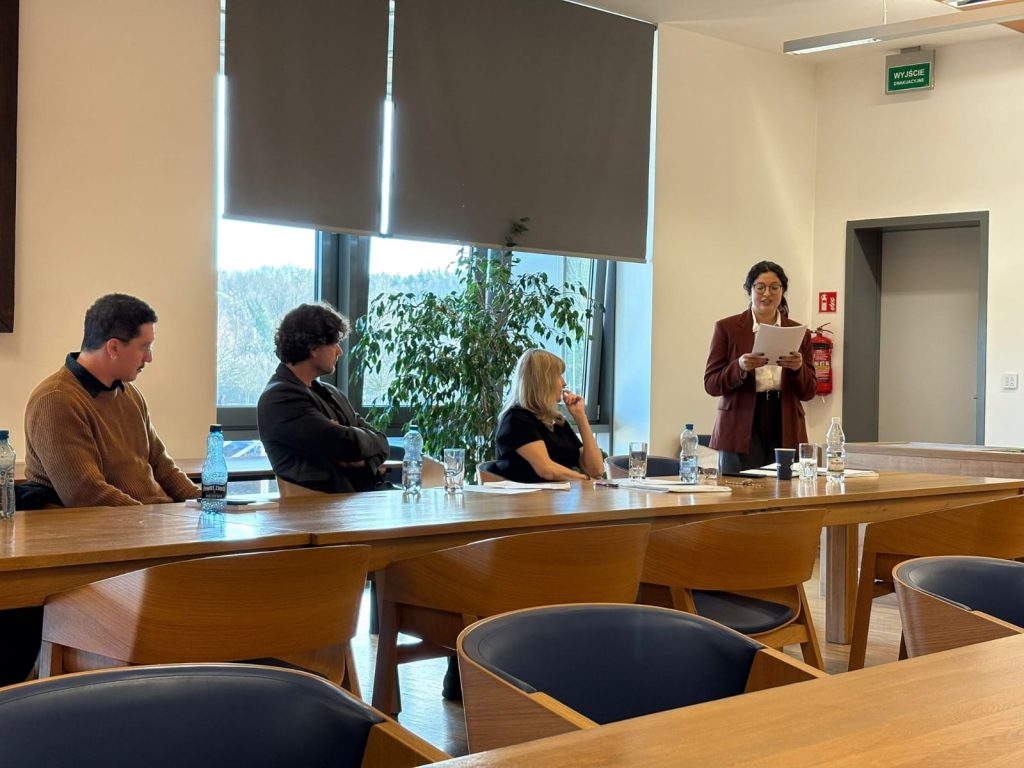
On December 11, 2025, Brazilian historian Taynna Marino* defended her doctoral thesis, titled “Empathy Beyond Anthropocentrism and Eurocentrism in Historical Theory,” at the Doctoral School of Humanities of Universidade Adam Mickiewicz (AMU) in Poznań, Poland. The work was completed under the supervision of Ewa Domańska (AMU) and Berber Bevernage (Universidade de Ghent), internationally recognized scholars in theory of history and the humanities.
The defense committee included three reviewers: Marta Kurkowska-Budzan (Universidade Jaguelônica em Cracóvia), Kalle Pihlainen (Universidade de Turku), and Rodrigo Turin (Universidade Federal do Estado do Rio de Janeiro). Faculty members from AMU’s history department also participated: Maria Solarska, Lucyna Błażejczyk-Majka, Tomasz Falkowski, and Krzysztof Makowski. The thesis was approved with distinction (summa cum laude).
In her thesis, the author investigates what it means to think about and practice history ethically in the twenty-first century, within a field still strongly shaped by anthropocentric and Eurocentric assumptions. On this basis, she proposes reformulating empathy as a theoretical, methodological, and ethical tool capable of challenging the limits of anthropocentrism, intellectualism, anthropomorphism, and Eurocentrism in theory of history. The proposal is organized around a conceptual triad: transcultural empathy, transspecies empathy, and intergenerational empathy.
The study reconsiders empathy in relation to nonhuman and more-than-human beings, other ways of knowing and inhabiting the world, and other temporalities, including past and future generations. It engages with a broad inter/transdisciplinary literature encompassing theory of history, animal history, studies of animal cognition and behavior, Indigenous knowledge, trauma studies, moral psychology, philosophy and moral ethics, the ethics of history, and debates on the Anthropocene. Empathy is treated as a concept that connects the ethical, epistemic, and political dimensions of historical knowledge production.
The study thus engages with urgent contemporary debates on climate change, environmental crises, and ecocide, as well as the legacies of colonialism, historical violence, genocide, war, and traumatic pasts. The author argues that empathy can play a central role in guiding more responsible historiographical practices that address historical injustices and help imagine fairer, more habitable futures.
*Taynna Marino holds a Ph.D. from AMU and master’s and bachelor’s degrees from Universidade Federal do Espírito Santo (Ufes). She is executive editor of Revista de Teoria da História and an associate member of RLTHH, INTH, SBTHH, and ANPUH. She has been a visiting researcher at Instituto Messerli de Pesquisa in Vienna, Universidade de Varsóvia, Universidade de Ghent, and the University of Oulu. She is the author of the articles “The Role of Empathy in Bridging Western and Indigenous Knowledges: Dominick LaCapra and Ailton Krenak” (Rethinking History, v. 26, no. 4, 2022) and “How Should Historians Empathize?” (History and Theory, v. 63, no. 4, 2024), and the book chapter “Empathy at the End of the World” in the collection Intra/Sections. Towards Post-Anthropocentric Concepts of Multiplicity, edited by Jenny Haase-Knöpfle and Kathrin C. Thiele (Brill/Fink, 2025). She also co-translated and co-edited “A história para além do humano” (FGV Editora, 2024), by Ewa Domańska.