
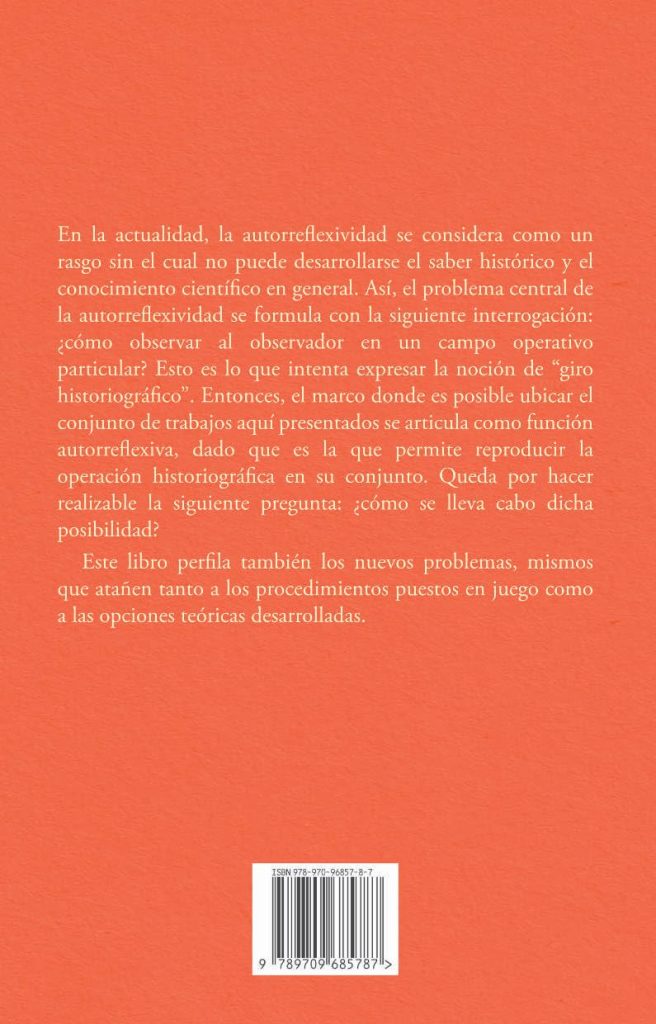
Ediciones Navarra presents a fundamental collective work for understanding current debates about historical scholarship in the 21st century. Coordinated by historians Fernando Betancourt (UNAM) and Daniel Ovalle (UAI), the book brings together research from academics across various Ibero-American countries that originally emerged in an international online seminar during the Covid-19 pandemic, organized by the same coordinators. Far from responding to a closed canon in the theory of history, this collection embraces thematic diversity and critical self-reflection as central axes for rethinking the discipline and its ‘historiographic operation’.
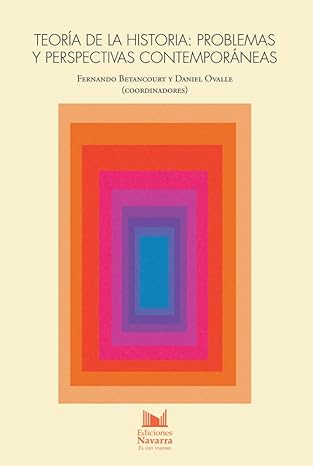
The following section outlines the central proposals of each chapter: The “giro temporal,” by the Argentine philosopher María Inés Mudrovcic, opens the volume analyzing how historical time has ceased to be seen as something ‘given’ and is now understood as a cultural and contingent construction. The author introduces the concept of ‘anthropochronism’ to indicate how history has traditionally been centered exclusively on the human, and proposes that the current climate crisis obliges us to redefine who constitutes the ‘we’ of history, integrating what is non-human. La literatura y la materialidad del libro, with historian Mehdi Mesmoudi, explores the complex relationship between literary writing and the book as a material device. Based on authors such as Foucault, Derrida, and Borges, he argues that literature is not merely an exercise in communication but an unfinished web where the work ultimately creates its own author and reading becomes a constant act of rewriting. In his chapter, Fernando Betancourt Martínez sketches a rethinking of scientific knowledge from the theory of autopoietic systems and second-order cybernetics. His main thesis affirms that knowledge is a property of organizationally closed systems and that the historian, as an observer, must assume that their operation is not neutral but introduces distinctions that shape the observed reality. Alberto Fragio, in “La epistemología histórica clásica”, critically reviews the neo-Kantian traditions that influenced figures such as Gastón Bachelard and Thomas Kuhn. The chapter highlights how the history of science is necessarily epistemological, focusing its analysis on the ‘breaks’ and ‘obstacles’ that have marked the development of human rationality over time. María Elisa Fernández analyzes the theoretical evolution of historian Joan Scott, showing how she moved from viewing gender as a social construction to incorporating it as an irresolvable dilemma based on fantasy and desire. This approach allows for the historicization of identity categories and questions normative truths about sexual difference in specific contexts. In El Panorama Bourbaki y la cultura visual, Silvia Pappe introduces the study of nineteenth-century ‘panoramas’ as visual devices that revolutionized the way historical events are represented. Through an analysis of the Panorama Bourbaki, the author demonstrates that historical knowledge is not solely fed by textual narratives but that visual media shape experiences of identification and historical consciousness through second-order observation.
The volume concludes with the proposal of Daniel Ovalle, who argues that current awareness of climate change is transforming modern conceptions of historical time rooted in progress, in line with the theses of D. Chakrabarty and Zoltan Simon. Ovalle postulates the need to develop a theory of history that transcends the division between humanity and nature, integrating ethical dimensions regarding the future of the planet and conditions for a ‘good life’ in the Anthropocene era. The proposal by Ovalle challenges the well-known thesis of Simon that we are living in a new temporal order which the Bielefeld University theorist called ‘unprecedented,’ by establishing that the Anthropocene remains a phenomenon that must be thought through from a processual rationality.
Teoría de la historia: problemas y perspectivas contemporáneas positions itself as essential reading for researchers and students interested in the current frontiers of historical thought, philosophy of science, and cultural studies. The book can be purchased online from the following platforms: www.amazon.com.mx https://ediciones-navarra.com/