Alesson Ramon Rota e Hélio R. Cardoso Jr.
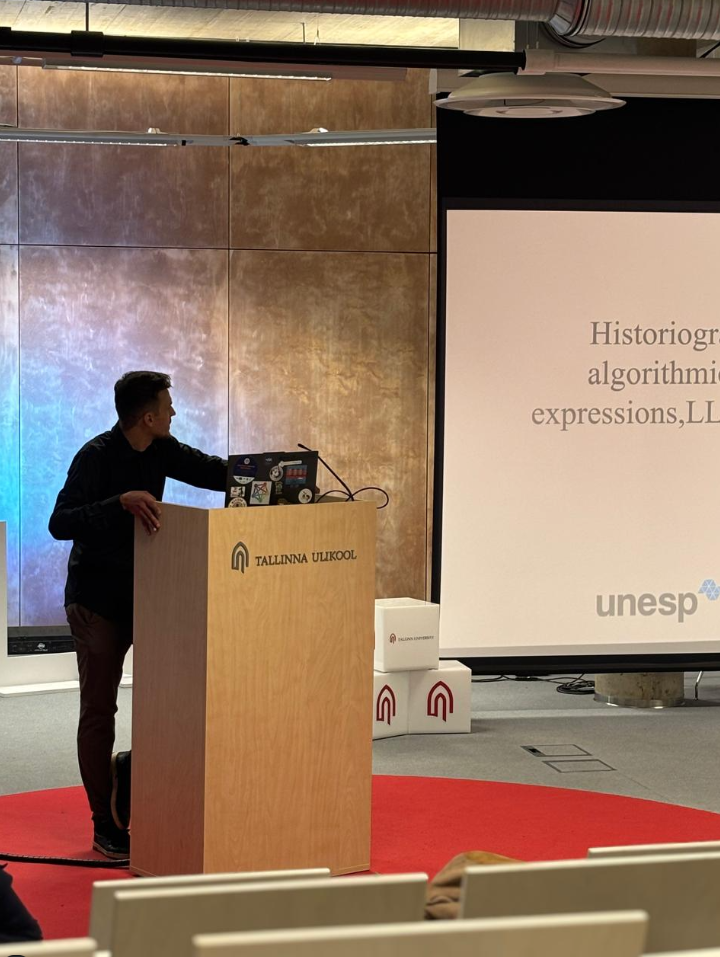
Título: Historiographical Classification in Algorithmic Environments: Regular Expressions, LLMs, and Human Verification
Resumo:
This article investigates the implications of digital memory for factuality and regimes of truth in the historical discipline, taking classification as a central operation in the production of historical knowledge within computational environments. It articulates Michel Foucault’s notion of regimes of truth, the historiography of digital history, and Paul A. Roth’s irrealism in order to examine how algorithmic classificatory procedures—such as regular expressions and large language models (LLMs)—mediate the constitution, preservation, and intelligibility of the past in digital contexts. The article argues that, rather than functioning merely as a technical support for disciplinary history, digital environments introduce new layers of mediation that directly affect historical evidence and truth, thereby requiring explicit protocols of traceability, transparency, and human verification. Drawing on Roth’s irrealism, it maintains that classification precedes historical description and explanation, allowing algorithmic models to be understood not as neutral instruments of representation but as active devices in the fabrication of historical objects. The argument is developed through the creation of an algorithmic model for an empirical exercise applied to the journal History and Theory (1960–2022), combining rule-based classification, human validation, and computational inference via LLMs. The study demonstrates that digital memory can sustain claims to factuality only when integrated into regimes of truth that preserve historiographical systems of reference, reaffirming the centrality of classification as a critical axis of contemporary digital history. Keywords: digital history; classification; algorithmic models.
 |
Alexandre de Sá Avelar
Título: Emil Cioran and History: Thinking the End to Rethink the Historical
Resumo:
Emil Cioran’s philosophical work is almost invariably associated with pessimism and a skeptical worldview. His dark writings have captivated authors as diverse as Susan Sontag and the Bolivian postcolonial thinker Javier Sanjinés. According to Paulo Jones de Lima Piva, some of Cioran’s books present themselves to readers as “an irreversible and reckless expedition into nothingness.” Certainly, titles such as On the Heights of Despair or The Trouble with Being Born may deeply unsettle those less familiar with the European intellectual climate of modernity critique—a sensibility already in the air since the late nineteenth century and which intensified after the two world wars. Cioran’s entire philosophical production is indebted to this moment.
His reflections on history—less frequently addressed by scholars of his work—are inscribed within the discourse of post-history or the end of history. But would it still be relevant today to revisit such questions, especially at a time when numerous efforts are being made to legitimize historical discourse in the face of the various forms of denialism that occupy public space across the globe? Or when Francis Fukuyama’s theses seem to provoke little more than indifference?
A more trivial justification might be this: as an analytic of historicity, history should be capable, in a self-reflective manner, of contemplating its own end. One might also argue that a perspective “outside of history” could serve as a productive path for reflecting on the very notion of the historical, as it is mobilized by historians. In short, post-historical conceptions such as Cioran’s may still speak to our contemporary world and offer insights into how we might think historically today.
“Abominable Clio” is one of many unflattering expressions Cioran used to refer to history. What, then, is so abominable that it must be overcome? In this presentation, I aim to explore two main aspects: first, the idea that history, as a modern project, has been annihilated by its own umbilical relationship with time. For time itself is an uninterrupted disequilibrium that continually collapses upon itself. History, therefore, can only be another form of disequilibrium—a haste toward a becoming in which nothing further can occur. It becomes a devastating machine that undoes individuals who, ironically, believed themselves to be constructing the historical process.
As a consequence of this realization, I turn to a second aspect: through what might be termed Cioran’s historiographical pessimism (if such a formulation is at all meaningful), I wish to consider the possibility of a history without time.
Ana Conrado Ferreira Rocha
Título: Beyond the Museum Walls: Memory, Movement, and Public History in Ouro Preto
Resumo:
The Museum of Inconfidência stands out in the Brazilian museum scene, as it is physically located in the city of Ouro Preto, the first Brazilian site to be nominated a World Heritage Site by UNESCO, and symbolically in one of the main pillars of Brazil’s identity construction: the Inconfidência Mineira movement, which took place stilll during the colonial period in the late eighteenth century. However, the museum’s exhibition narrative sacralizes hegemonic views of Brazilian history, based on exclusionary and racist assumptions. In contrast, I propose a route of memory that explores the city of Ouro Preto to relocate historical agents excluded from institutional memory in the urban environment, reimagining their roles and challenging the museum’s narrative from the city’s perspective. This approach is aligned with Ariella Azoulay’s (2024) concept of “potentializing” history, offering a way to confront the symbolic boundaries between marginalized groups and dominant historical narratives. Museums, monuments, and commemorations are tools for legitimizing these dominant histories, making it imperative, therefore, to rethink spaces of memory.
Following Azoulay’s idea of going beyond the “master’s tools”, referring to the poet Audre Lorde, I intend to develop a historical knowledge that embraces difference as a transformative force. The city, history, and community must be central to this approach, and Public History has the potential to facilitate this change by promoting a pluralistic historical culture. I argue against the view of museums as the definitive guardians of history, especially given their colonial legacy. In light of this, I suggest that walking through the city can provide an alternative space to engage with history, especially with sensitive pasts, understanding knowledge traversed by bodily movement in the act of walking. The didactic intervention, put into practice, reveals itself as a fruitful teaching possibility, committed to the notions of experience proposed by Bondía (2002), anchored, therefore, in the needs to “cultivate attention and delicacy, open our eyes and ears, talk about what happens to us, learn slowness, listen to others, cultivate the art of encounter, be silent a lot, be patient, and give ourselves time and space”(Bondía, 2002, p. 19).
Thus, there is a clear need to recognize new possibilities of approaches and counter-hegemonic narratives, seeking to understand the Museum of Inconfidência and the so-called heritage city of Ouro Preto in a dialogical way, seeking to give due prominence to issues related to socially alive pasts. Therefore, we defend the need to enhance history (Azoulay, 2024) and the museum, starting from epistemic and aesthetic disobedience (Mignolo, 2018) in the museum space, through the realization of a route of memory.

Augusto de Carvalho
Título: The Entanglement of Past Time and the Existential Meaning of Historicity
Resumo:
The Entanglement of Past Time and the Existential Meaning of Historicity Based on the theorization of temporal entanglement, this paper aims to present an explanatory hypothesis regarding the deep temporal significance of the concept of historicity. Through a brief overview of the term historicity—from its technical, historiographical, and philosophical origins to its existential configuration as developed by Martin Heidegger —I will examine the critiques concerning the applicability of this concept within the fields of Philosophy and the Theory of History. My objective, therefore, is to scrutinize the most fundamental temporal reference within the philosophy of historicity: the idea that, precisely because we are necessarily affected by the passage of time —as expressed in the well -known Heideggerian dictum —there exists a temporality that conditions human, and even non -human, existence. This condition has been termed historicity, referring to the temporal character of existence that enables us to exist in a historical mode and to think historically about existence as such. Thus, my aim is not merely a philological exercise, but also a reflection on the usefulness of historicity as the so-called ontological foundation of the historical phenomenon—that is, historicity as evidence of the existential rule to which any concept of history is subject, precisely because it always has, as its substance, a phenomenon of temporal nature. These Heideggerian existential insights, however, do not adequately address why and how time conditions our existence. To engage with these questions, I turn to J. M. E. McTaggart’s reflections on time, arguing in favor of an investigation into the logical nature of the past for a proper understanding of why and how the passage of time entangles our existence. In short, my hypothesis is that time passes insofar a s the inherited past is entangled with the past that is constituted as such through tradition or decision —one has always had a past and will always become past. In the existential sense, one is always ambiguously positioned before the pastness of time in a profoundly contradictory way. In McTaggart’s terms, it is precisely that illogical and contradictory form of the past which, paradoxically, ensures the passage of time. According to my proposal, this is the very origin of the temporal entanglement to which the concept of historicity refers.
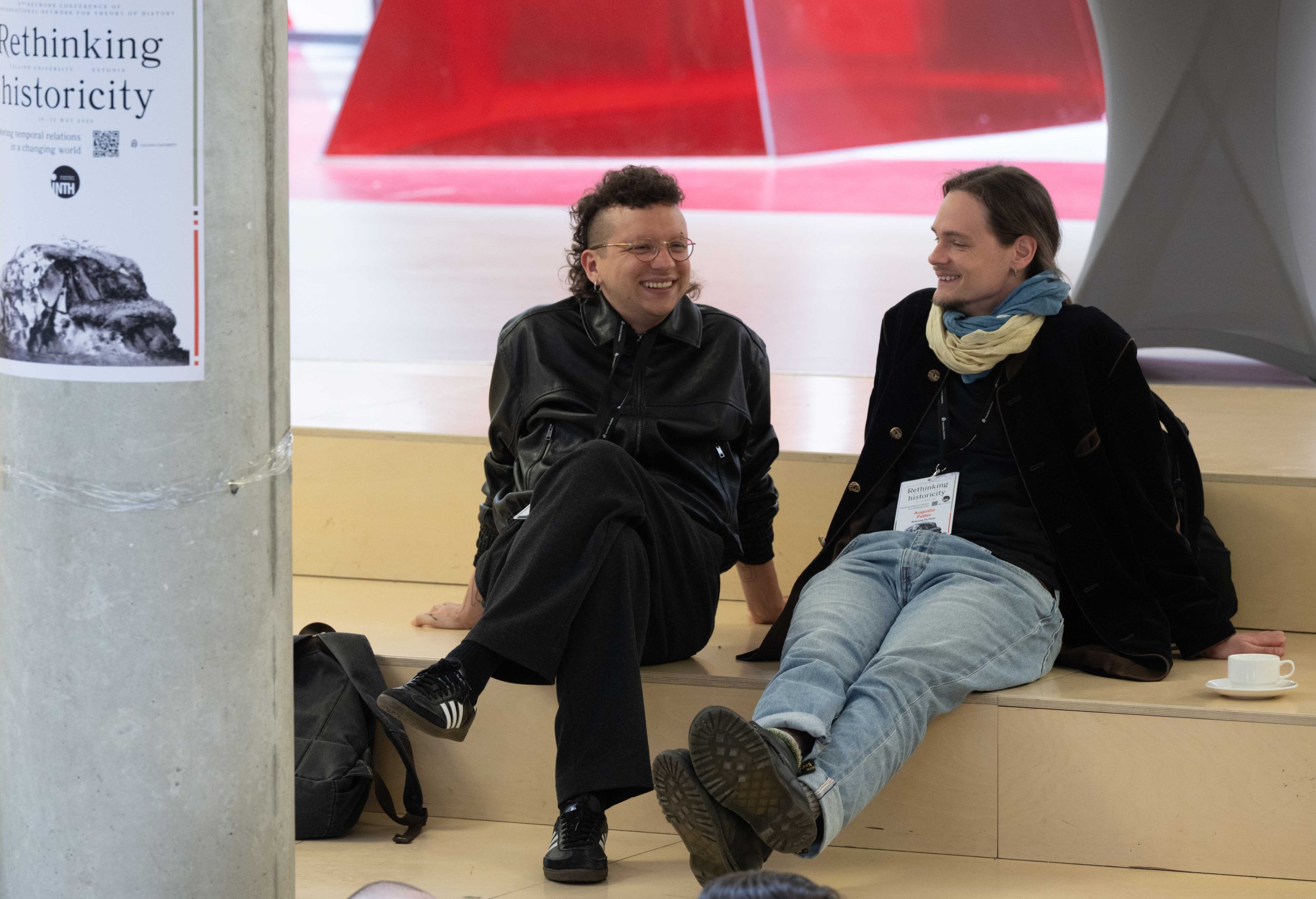
Augusto Petter
Título: Finitude and Technology: Silicon Futures of the Dark Enlightenment
Resumo:
This paper critically examines the political instrumentalisation of the future by tech elites and Dark Enlightenment [DE] thinkers. Figures such as Peter Thiel and Curtis Yarvin (aka Mencius Moldbug) often draw from seemingly complex cosmopolitical narratives to legitimise their radical horizons of expectation for post-capitalist superintelligence, life extension, and techno- authoritarianism. Their engagements with ideas of progress and decadence —from Musk ’s ambition to expand human civilisation in time and space beyond Earth’s limited planetary environment, to Thiel’s techno -ideological opposition to ‘left-wing dystopian scenarios ’— reveal a future-oriented form of historical consciousness. Their ideas address modern history simultaneously as a period of technological progress and social decay. Claiming the importance of ontologically distinguishing these two processes, the techno-neo-reactionaries state that technological acceleration will lead us to ‘right’ and more authentic forms of living –even if it consists of giving out our destiny to the ‘hands’ of new silicon forms of life. Drawing on the DE ideologues’ readings of Ludwig von Mises’s notion of inherited will and Hobbesian political theologies, the DE casts itself as carrying forward the voice of a humanism through transhumanism . It proposes that machines can control, inherit and reproduce what is human, thus continuing human history. Such narratives often advance an ethical imperative to overcome mortality —turning speculative possibilities ( rooted more in fiction than in history) into moral obligation. Thus, this paper explores the DE ontological grounds implicit in ethical visions of cryonics and post- human futures. The past, for instance, donates its place to the fantastic world of J. R. R. Tolkien or to mythological cosmic times evoked in Lovecraftian scenarios. In this case, h istory is understood as a fiction, a less imaginative one, that is sometimes still called out to ‘naturalise’ human tendencies to create hierarchies or to proclaim that capitalism works as an organic and rational process. By tracing how past, present and future are mobilised within the ideological frame works of the Dark Enlightenment and ultra -accelerationist thought, the paper questions whether futurism functions as a regime of historicity—in a nineteenth-century fashion—where the idea of progress once again takes the lead. In what ways are these new forms of historicity shaped by crises of capitalism and the spaces of experience of Silicon Valley; and lastly, how does fiction seem to take the place of history to serve as ideological infrastructure for elite techno -political projects? Ultimately, to answer these questions and to diagnose the historicity of the Dark Enlightenment, I summon Koselleck’s anthropologico -existential categories of space of experience and horizons of expectation, and Dominick LaCapra’s and Mark Fisher’s hauntological approaches to texts. The first will help to unveil the weight of past and future in their historical understanding, and the latter, to shed light on the ghosts of the finitude of capitalism that haunt the post-historical world of Silicon Valley. Dr Augusto Petter teaches at Sciences Po Paris. He holds a PhD from the European University Institute in Florence, Italy. He has experience researching history of time, modern monarchies and philosophy of history. Augusto is a member of the Modern Monarchy in Global Perspective Research Hub (University of Sydney). He currently teaches courses on Necropolitics, Posthumanism, and Theory of History. His research interests centre on the exploration of apocalyptic narratives and the aesthetic and temporal aspects of sovereignty.
Aurelia Valero Pie
Título: On Restitution: Turning Back the Wheels of Time in Colonial and Postcolonial Mexico
Resumo:
Although claims for restitution are nearly as old as the acts of dispossession themselves, there seems to be a resurgence in recent years. As is frequently reported in the press, governments and certain ethnic groups are increasingly demanding the repatriation of historical artefacts, especially if they were taken away by means considered unjust, whether through colonialism or outright theft. To a certain extent, those claims can be regarded as an effort to eliminate the lingering effects of colonial rule, to achieve a form of historical justice, and, in a sense, to undo time. I will try to provide in my presentation a general overview of the historical development in Mexico of the concept of “restitution,” spanning from the colonial era to the present. The first claims for restitution can be traced back to the 16th century, when friar Alonso de la Veracruz appealed to the Spanish Crown to compensate the damages brought by the Conquest to the people of the New World. However, it was not until the 19th century that claims for restitution began to refer to objects and take on the meaning of ‘restitutio ad integrum’. I will finally draw on a few examples from contemporary Mexico, particularly the case of Moctezuma’s headdress, which is currently on display at the Weltmuseum in Vienna. This example will hopefully demonstrate two things; firstly, that restitutio ad integrum is no longer a possibility, even in the objectual domain; and secondly, that it functions as an index of temporal experience.
Caroline Silveira Bauer
Título: Memories of Capitalism: Possibilities for Reparation Related to the 1964 Dictatorship in Brazil and Public Demands for History and Historians
Resumo:
This paper presents the research entitled “Memories of Capitalism: Possibilities for Reparation Related to the 1964 Dictatorship in Brazil and Public Demands for History and Historians.” The study starts from the observation that the Brazilian civil-military dictatorship (1964-1988) left a legacy of economic, human, political, and social consequences that persist today. Over the last three decades, the Brazilian state has implemented memory policies aimed at redressing the crimes committed and officially recognizing the victims. More recently, an interdisciplinary academic debate has explored the possibility of reparations that, on one hand, advance the process of accountability by directing it towards private actors, notably businessmen, and that, on the other hand, move beyond the scope of individual monetary compensations, proposing mechanisms for collective reparation capable of fostering structural transformations in society. In parallel, historiography has reflected public demands for history and its professionals, questioning the definition of “historical reparation” and its limits and possibilities. The notion of “memories of capitalism” underpins this approach, premised on the understanding that the transformations of the 20th century, including authoritarianism and violence, profoundly reconfigured relationships with the past and temporality, demanding new perspectives on memory, forgetting, and time. Reparation, which encompasses legal and symbolic dimensions, involves complex ethical, legal, and moral questions, articulating concepts from philosophy, history, and law, such as guilt and forgiveness, recognition and responsibility, dosimetry and penalties. By analyzing memory policies directed at private sectors, it is possible to align them with the concept of “transitional justice,” given that both spheres seek, to different extents, to ensure fundamental rights, such as the right to justice, memory, and truth. Nevertheless, conventional transitional justice practice tends to rely on individual reparations, proving limited in promoting the structural changes necessary to prevent the recurrence of human rights violations. In this context, the research indicates the pertinence of recognizing capitalism as a system and rationality that fostered the dire consequences of the dictatorship, proposing a reflection on a potential historical reparation that operates within capitalism and, simultaneously, against its logic. This conception of reparation assumes a perspective of “historical debt,” often invoked in contemporary political discourse, and evokes the idea of a “tribunal of history.” Thus, history, memory, and law, albeit through distinct avenues, converge on the objective of managing the past, materialized in memory policies. Consequently, the research is guided by the following question: would there be a specificity to reparations for benefits gained and crimes committed by private actors in dictatorial contexts? As a provisional answer, it is suggested that historical narrative be understood as a communicative action deeply imbricated with morality—albeit indirectly. Such a perspective would explain the persistence of a past that “does not pass,” not only due to the absence of a collective processing of traumas but also because of its constant presence, which warns of and establishes indelible links between the past and the present.
Daniel Brauer
Título: The Narrative of Another Life: Intersubjectivity and Multidimensionality of Bio-graphical Time
Resumo:
In recent years there has been a renewed interest in the epistemological status of biography, and this for various reasons. Considered a hybrid genre between history and literature, it has been both expelled and claimed by both. In the case of history, the rejection has stemmed from the dominant paradigm in twentieth -century academia regarding the fundamentally social character of human events. This is true both for Marxist historiography and for the Annales school, as well as for various currents of social history reacting against dynastic history, national-hero narratives, and the like. The role of individuals was, in any case, regarded as marginal, and biography, consequently, as a minor and derivative genre. From the literary point of view, precisely its factual grounding would limit the achievement of a fully literary work. Although biographical narrative never ceased to be popular, only in recent years has it gained renewed theoretical interest. This is due in no small measure to the rise of the culture of memory and testimony, as well as to the emergence of microhistory, albeit from a new perspective. From the standpoint of philosophical reflection on biography, we must undoubtedly return above all to the works of Dilthey, Georg Misch, and Wilhelm Schapp on the one hand, and more recently Paul Ricoeur on the other. For the first, autobiography and biography provided models for historical writing in general, whereas the latter, with his notion of “narrative identity, ” approaches a reconsideration of biography, though he has only marginally engaged with it. Nevertheless, he has situated the discussion of t he role of narrative within the broader framework of a theory of temporality, something that in Dilthey appears only in outline. Biography does not seem to fit easily into the scheme of distinguishing between physical time and subjective time, on the one hand, and ‘human’ time as constituted in historical and fictional narratives, on the other. The time of a life trajectory integrates these dimensions, but cannot be reduced to them. The same applies to the specific kind of narration that describes a life. In this paper, I propose an approach that seeks to account for the complexity and multidimensionality of biographical time.
Fernando Nicolazzi
Título: Between Discipline and Profession: Public Perceptions of History and Historians (Brazil, 21st Century)
Resumo:
The production of historical knowledge in contemporary Brazil has been undergoing a series of transformations and shifts that affect both the disciplinary status of its practice and the professional status of its practitioners. The paper aims to share preliminary results of the research project “Between Discipline and Profession: Public Perceptions of History and Historians (Brazil, 21st Century)”, whose main goal is to map and interpret public perceptions regarding the discipline of history and the work of historians in contemporary Brazil. Starting from the prior observation of transformations and shifts that affect both the disciplinary status of historical knowledge—marked, among other factors, by a loss of social legitimacy—and the professional status of its practitioners—evidenced by the approval of Law 14.038/2020, which regulated the profession of historian—the proposal argues that understanding the meanings of this apparent paradox (a renewed professional relevance in a context of disciplinary legitimacy crisis) is essential to rethink the place of history and historians in Brazilian society, as well as to suggest ways of reconciling profession and discipline in light of public demands and social expectations directed toward historiographical practice and its practitioners. Such demands and expectations are considered here through the notion of public perceptions, the main object of analysis, which can be grasped through different materials. For the purposes of this project, the following sources will be primarily taken into account: legislative processes related to the discipline and the profession; public job calls for the position of historian between 2007 and 2025; undergraduate curriculum of History Programs in Brazilian universities; quantitative surveys carried out among the population of Porto Alegre between 2024 and 2025. The hypothesis guiding the investigation is that attention to public perceptions of history and historians allows for a better understanding of how different audiences relate to the discipline, as well as the various modes of social representation of its professionals in a given context.
Guilherme Bianchi
Título: Living and remembering conflict in Peruvian Amazonia: non-human agency, collaborative history, and politics of memory
Resumo:
This presentation focuses on the history of Indigenous organizations in the Peruvian rainforest during and after the internal armed conflict (1980–2000), examining how these organizations navigated the years of violence and continue to face the current challenges of territorial defense and political legitimacy. The starting point is the tension between memory and violence: how can one speak of ‘post-conflict’ when extractive projects, drug trafficking, and intercommunity mistrust continue to reproduce the conditions of destruction? In this context, remembering and forgetting are not only processes of memory but also political practices that shape belonging, reconciliation, and resistance. This research draws on fieldwork in Peruvian Amazonia, combining interviews and archival work about the history of the Ashaninka people. Shared authorship is a guiding principle: Indigenous interlocutors are not treated as ‘informants’ but as theoretical partners, whose historical interpretations challenge conventional categories of historiography, particularly those related to historical agency. The theoretical reflection unfolds in three directions. First, the ‘archive’ is rethought: rather than a static repository, it is conceived as a living practice, marked by non-linear temporalities in which past, present, and future coexist. Second, the category of ‘historical agency’ is reconfigured: Ashaninka narratives show that action during the conflict was not exclusively human. The consumption of plants and the activation of spiritual relations shaped decisions, strategies, and collective survival — plants and spirits were not symbolic references but active participants, expanding the notion of agency beyond human intentionality. Third, collaboration is analyzed as a politics of memory and shared authority, understood not merely as a method but as a political gesture that reconfigures epistemological hierarchies and opens new possibilities for theoretical approaches to the past. By advancing a model of coauthored historical writing, this research seeks to broaden the scope of the theory of history. Ashaninka memories are not approached as raw material but as Indigenous theories of history in their own right, capable of reframing concepts such as agency, temporality, and historical sources. Remembering and forgetting thus emerge both as objects of analysis and as methodological and political practices, redefining the very meaning of writing history in contexts marked by violence and the struggle for political recognition in contemporary Amazonia.
Hugo Ricardo Merlo
Título: Playing with time: experimentalism and alternative experiences of historicity
Resumo:
This paper explores the possibilities of experimental history as a mode of historiographical practice that not only exposes the limits of representationalist historiography but also opens pathways toward alternative experiences of historicity. Building on Alun Munslow’s formulation of experimental history (2010) as an emphasis on form over content, I argue that experimental works—literary, historiographical, and theoretical—engage time not simply as an object of representation but as something to be played with, disputed, and reconfigured. This orientation resonates with earlier calls for experimental history, from the French Alter histoire (1991) collective to Massimo Mastrogregori’s reflections on storia sperimentale (2003). It also connects with interventions by Hayden White, Frank Ankersmit, and Dominick LaCapra (2007), as well as recent engagements with presence (Gumbrecht, Runia), hauntology (Mark Fisher), and spectral temporality (Kleinberg). Taken together, these dialogues suggest that experimental history is less a historiographical style than a laboratory for testing how time itself can be experienced. My point of departure is that representationalist historiography tends to temporalize time in an inauthentic way, framing it as a succession of past–present–future and grounding meaning in the immanence of historical facts. Experimental works, by contrast, can enact alternative chronopolitics. They invite us to inhabit presence (Hans Ulrich Gumbrecht’s In 1926), to experience non-human temporalities (Éric Baratay’s Le point de vue animal), or to confront repressed and spectral pasts (Saidiya Hartman’s Lose Your Mother). In each case, form becomes a means of temporal intervention: not just narrating history, but re-staging, re-presentifying, or fabulating temporalities that exceed linear sequence. I propose, therefore, to read experimental history as a future-oriented practice in Ewa Domańska’s sense: an experimental engagement with temporalization that unsettles the historicist order and rehearses alternative ways of inhabiting past, present, and future. Rather than treating experimentation merely as a critique of representation, I emphasize its generative dimension—its ability to make time perceptible otherwise, and to gesture toward more desirable futures. In this light, experimental history does not simply supplement established historiography; it redefines its horizon by foregrounding historiography’s capacity to transform how we experience historicity itself.
Ian Kisil Marino
Título: Disruptive Archives? Senses of History and Time in a Digital and Catastrophic World
Resumo:
Since the global dissemination of internet access (the so-called Web 2.0) and the massification of personal digital gadgets (from computers to smartphones), the ways through which one can document events and create digital spaces for sharing such records online have multiplied. Studies on digital archives regarding collective catastrophic events in the first decade of the 21st century, such as the September 11th Digital Archive and the Hurricane Digital Memory Bank, can now be seen in perspective alongside more recent projects, such as a multitude of archiving initiatives regarding the COVID-19 pandemic worldwide, wars in Ukraine and Syria, and even natural catastrophes, such as earthquakes in Turkey and Japan, among many other examples. The main elements that allow one to perceive such plural projects as a coherent global-scale phenomenon are the massive use of digital technologies, the evident aspect of collaboration via crowdsourcing or other strategies, and the fact that they always seem to respond to events that are somewhat collective, catastrophic, and traumatic. Studies on such forms of “real time archives” have so far focused on mapping the new actors that comprise this scene – as well as their strategies to compose such collections. In the fields of digital history and digital humanities, research has focused on debating the purposes that digital media fulfill in such cases as well as the challenges of digital preservation for such materials. On a more theoretical front, some studies have debated the very notion of “archive” in this context, weighing the specificities of this phenomenon and how historians can properly address such projects and documentation. Few studies have offered a theoretical reflection on how this archiving phenomenon impacts the senses of historicity and the epistemic constitution of the historical discipline. What type of history do such archives perform? Do these archives imply any specific relation or perception of time? How can the immediate reaction to mass catastrophic events be perceived in their modulations of past, present, and future? Is there a specific ethics in the way such archives deal with history and historical records, and, if so, what does that mean for the historical discipline? Can these very questions even be asked on a global scale, or are there particularities that counter the globalization of digital transformation, avoiding any possibility of historiographic universalism? This paper takes these questions seriously and answers them by offering a global and comparative perspective on such disruptive archiving phenomena on a global scale.
The paper delves into specific case studies from different 21st-century archiving initiatives around the world, such as the September 11th Digital Archive, many COVID-19 pandemic archives in Latin America, Africa, and Europe, war archives in Ukraine and Syria, and climate catastrophe archives in Asia, to offer a unique comparative exploration of such projects. Instead of offering a descriptive view of them, however, the paper presents theoretical reflections on how these archives echo matters of time and history – arguing that such questions are fundamental for reflecting on the pathways for history and historians in the 21st century.
Jacinto Páez Bonifaci
Título: Re-enactment and Historicity: Collingwood’s Transcendental Account of Historical Continuity
Resumo:
This presentation investigates R. G. Collingwood’s doctrine that historical knowledge requires the re-enactment of past thinking as a contribution to current debates on historicity—that is, on how temporal relations are constituted, experienced, and narrated. Collingwood defines the concept of re-enactment in various passages across his published works as well as in his research manuscripts and lectures. One of the chief difficulties raised by his theory concerns the polysemy of the terms and meanings associated with the concept. Terminologically, one finds the interchangeable use of expressions such as “re-think,” “re-create,” and “reconstruct” throughout his oeuvre. As for meaning, the Autobiography alludes to the “encapsulated” character of past thoughts in the present (Collingwood 1939: 114), whereas The Idea of History emphasizes their “continuant” character (Collingwood 1994: 286). Although re-enactment is the cornerstone of the understanding of history, its formulation is far from clear or unequivocal. Indeed, the very attempt to articulate it seems to have been the most significant stumbling block Collingwood encountered in the overall formulation of his philosophy of history. Interpretively, the problem on which I focus here is the claim that re-enactment, as a condition of historical knowledge, requires an exact revival of the original act of thought itself, that is, that the relevant act of thought is a continuant across time (Collingwood 1994: 175; 1994: 303; Levy 2025: 19). For Collingwood, such exactness is an indispensable requirement if we are to speak meaningfully of historical knowledge. But what does “exactness” mean in this context? William Dray maintains, for example, that the relation between the original act and its re-enactment concerns the “rational force” of thoughts (Dray 1957: 431), whereas Giuseppina D’Oro construes exactness as a predicate of the inferential patterns proper to the thoughts in question (D’Oro 2000: 96). More recently, Mark Robson has developed an interpretation that emphasizes the continuant character of thought (Robson 2024), an interpretation that in turn requires considering thought, as action, as an object in the world (Robson 2024: 105). In any case, these different defenses of the theory of re-enactment acknowledge the need to incorporate further conceptual resources to elucidate a theory that appears, in itself, obscure and indeterminate. Against the alternatives posed by the specialized literature on Collingwood—from Dray (1957) to Levy’s (2025) objections—this paper advances the following claim: the continuant character of thoughts can neither be understood nor dismissed in terms of a theory with realist implications, nor can it be accounted for solely by appeal to the rational or inferential commitments of thought. Rather, to grasp the metaphysics underlying re-enactment, Collingwood’s theory must be construed as a transcendental one—that is, as a reflection on the way in which the historical object is constituted by the knowing subject. Within this framework, it evaluates the viability of a conception of re-enactment that, while acknowledging its metaphysical commitments, avoids the aporias highlighted by contemporary criticism.
João Ohara
Título: Historians and Trust
Resumo:
Epistemic dependence is pervasive: we depend on others to know all sorts of things about the world and even ourselves. Given our finite resources and capacities, we choose to be more or less epistemically autonomous in different subjects. Researchers, however, are usually thought to be epistemically autonomous in a stronger sense. That is, we often assume researchers have a tighter grasp on their areas of expertise and, as such, are able to judge autonomously and come to their own conclusions. In the case of historians, R. G. Collingwood was one of the authors who defended the view that epistemic autonomy is a necessary condition for the scientific historian. Scientific historians distinguish themselves from their predecessors (famously dubbed ‘scisors and paste historians’) through their refusal to accept testimony at face value. Testimony, for the scientific historian, is taken only as further evidence to be weighted by the historian in their autonomous reasoning process. That view has come under criticism by C. A. J. Coady, who argued that historians do, in fact, depend on testimony in ways that go beyond their evidentiary role. More recently, however, Collingwood’s view has been defended from Coady’s criticisms. While I mostly agree with these defenses against Coady regarding the status of testimony of past agents, there is another sense in which Collingwood’s view faces problems. In this paper, I will argue that historians are fundamentally dependent on their peers, their epistemic community, to acquire historical knowledge, and that this dependence implies trust, rather than mere reliance. No historian can get hold of all the relevant evidence necessary for the acquisition of historical knowledge in the sense usually assumed by historians themselves, and so historians invoke the conclusions of other historical investigations as parts of their own accounts. Historians trust (at least some of) their peers to have done their jobs in good faith and use their testimony as part of their own reasoning process, not in the role of evidence, but rather as auxiliary assumptions or background knowledge. This leads us to a more detailed and nuanced, though weaker, version of epistemic autonomy.
Jônatas Pantoja
Título: Historians and the emergence of the professional field in the United States (1880-1930)
Resumo:
This paper aims to analyze sociologically the first two generations of United States professional historians, who made their careers between the 1880s and 1930s. This period covers the initial phases of institutional consolidation and the conflicts surrounding disciplinary legitimacy. Considering that scholarly activity is inextricably linked to the social conditions in which it occurs, this research intends to explain how certain social properties, related to social origin, training, and ideological approach, influenced the trajectory and polarized the theoretical profile of the agents (orthodox vs. heterodox). It explains the emergence of historical scholarship as a professional field, regarding the social conditions and their impacts on the historians’ profession. Through prosopographic methodology, Multiple Correspondence Analysis (MCA), and primary documentary sources, such as letters and memories, the investigation provides a detailed picture of the social trajectory of 85 agents involved. It highlights the strategies for carrying out projects of a professional nature, emphasizing the effects of the frameworks and the social changes in the period. By showing the connections between scholarly activity and the institutional circumstances of the appearance of opposite historiographical models, this research intends to contribute to the studies in the history of historiography and sociology of knowledge. One of the central points is to analyze the dispute over the legitimacy of the discipline through the prism of the social and institutional transformations that the United States underwent at the turn of the 20th century. The main links that give intelligibility to the process include the modernization of universities and the advent of the middle class, progressivism, philanthropy for research, and the publishing market.
José Antonio Vasconcelos
Título: History, Anthropology, and the Question of Time
Resumo:
The paper explores the complex and often porous boundaries between history and anthropology, emphasizing their distinct relationships with time. Since the early 20th century, anthropology has inspired historians to reconsider their objects, methods, and approaches. This interaction produced hybrid genres where historians adopted anthropological concepts and anthropologists engaged with historical subjects. Clifford Geertz observed this cross-pollination in works that blurred the disciplinary lines, showing how historians and anthropologists frequently “mind each other’s business.” The text traces how anthropological concepts, particularly the idea of culture, attracted historians from the 1930s onward. Cultural history emerged as a field seeking to capture collective worldviews and mentalités, reacting against the limitations of social history. The “cultural turn” of the 1970s reinforced anthropology’s influence, especially through Geertz’s interpretive method of “thick description,” which offered historians tools to analyze symbolic meanings within societies. Conversely, structuralist anthropology, associated with Claude Lévi-Strauss, proved less influential among historians because of its static models and its suspicion of history as a discipline. Nonetheless, Lévi-Strauss’s emphasis on structures and unconscious cultural patterns highlighted an implicit temporal dimension, though often in tension with historical concerns for change and diachrony. The article contrasts Lévi-Strauss’s structuralism, which privileges synchrony, with Geertz’s interpretive anthropology, which focuses on meaning and symbolic systems. While structuralism risks minimizing historical specificity, Geertz’s approach resonates with historians because it parallels their work with texts and symbols, even if Geertz himself often neglects historical change. Historians selectively draw from anthropology, favoring approaches that accommodate historical intentionality—the indirect but necessary reference to time. Paul Ricoeur’s concept of historical intentionality and Fernand Braudel’s focus on the longue durée highlight how history differs from the social sciences: it cannot avoid engaging with temporality. The text also considers criticisms of anthropological influence on history. Some fear that excessive reliance on interpretive models fragments the discipline or risks moral relativism, while others insist that historians must always situate small-scale studies within larger social processes. Yet examples from microhistory, cultural history, and symbolic analysis demonstrate both the promise and pitfalls of borrowing anthropological methods. In conclusion, what ultimately distinguishes history from anthropology is not the size or the nature of its object of study but its specific engagement with time. While anthropology may privilege structures, symbols, or meanings, history is defined by its narrative relationship to temporality—succession, simultaneity, and change. The appeal of Geertz to historians lies in his semiotic approach to culture, which provides interpretive tools adaptable to historical contexts, while the challenge of Lévi-Strauss’s structuralism lies in its uneasy relationship with time. The essay suggests that a productive dialogue between the two disciplines depends on historians’ ability to recognize and articulate diverse temporalities within their narratives.
Juan A. Fernández Meza
Título: Historicity and Difference: A Theoretical Approach to Historical Fiction
Resumo:
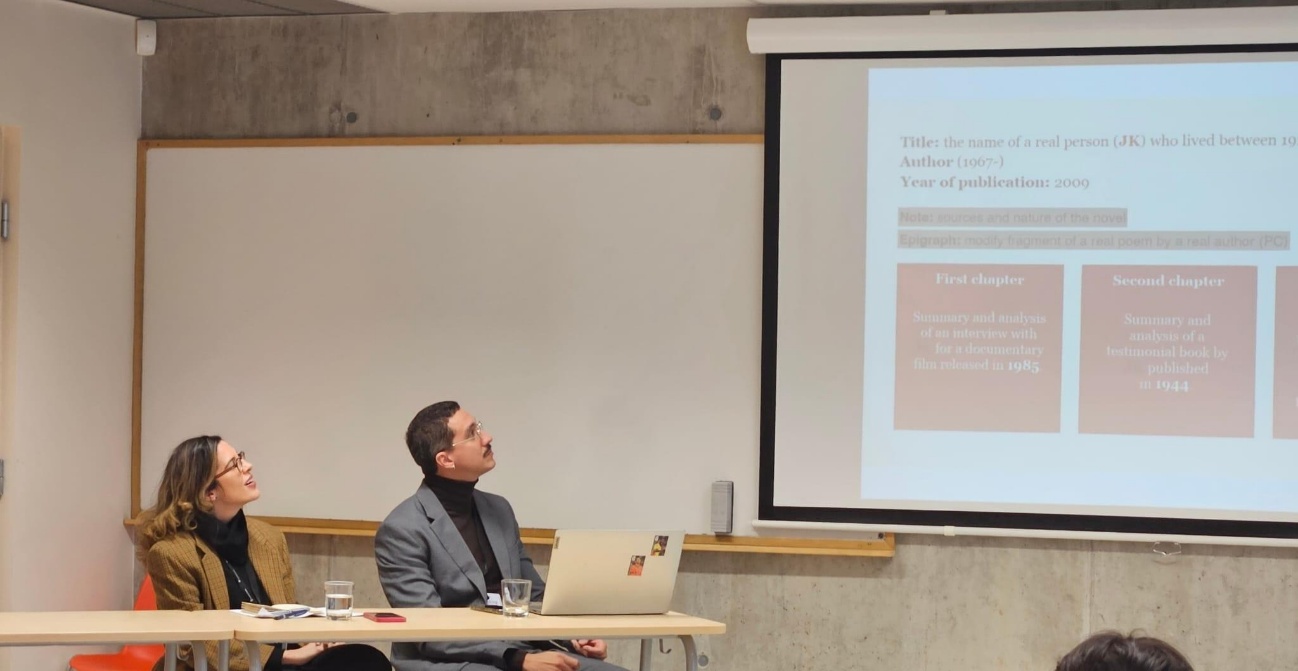
This paper aims to explore the concept of historicity by analysing the literary approach of the French author Yannick Haenel in his novel Jan Karski (2009). The novel, named after Jan Kozielewski (Karski)—a Pole and courier for the Polish resistance during the Nazi occupation— presents a first-person narrative that addresses issues lacking documentary evidence, particularly in its third part. The first part is an account of the film Shoah (1985) by Claude Lanzmann, and the second part recounts Karski’s book Story of a Secret State (1944). Following its publication, the novel sparked significant controversy among historians and various figures in French cultural circles associated with the narrative of the Shoah. From then onwards, scholars from different European countries and the Americas have published essays on the work, primarily because it directly challenges the boundaries through which history constructs the representation of the past, the validity of testimony as a historiographical source, the tension between multiplicity and uniqueness in the concept of truth, and the ethical considerations involved in referencing the past. Returning to the various criticisms levelled at Haenel for using the real name of the Polish resistance to create a work of fictional literature, this essay aims to explore what happens when that name enters the fictional realm, where a fracture is established between the person and the character, revealing a distance that can be seen as the difference between reality and narrative. The voice of the fictional Karski in Haenel’s novel illustrates, among other things, the historicity of Karski’s testimony, which varies and can even be contradictory across different accounts. The Pole adapted his recollections according to the circumstances or the listener to whom he spoke of his past as a resistance fighter; this will not be the focus of scrutiny in this study, at least not in terms of verifying his account, but rather to highlight the historicity of the testimony. Haenel’s fiction serves as a metaphor for that historicity, emphasised by the difference between person and character. Therefore, this study aims, through analysing the novel in question, to explore the concept of historicity in relation to that of difference.
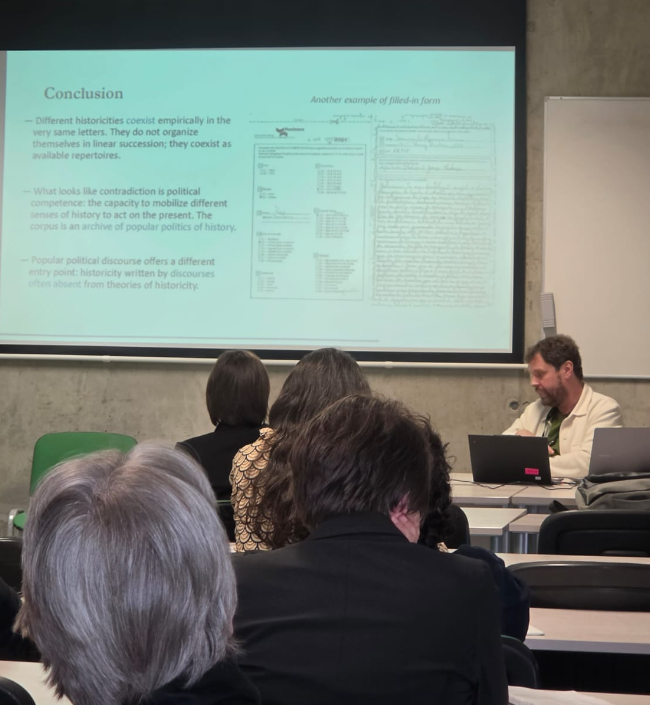
Lara Lucena Zacchi
Título: Conceptions of time and Political Demands in the Letters of the Rede Nacional de Mães e Familiares de Vítimas do Terrorismo de Estado no Brasil (2016-2022)
Resumo:
This work addresses the ways in which the National Network of Mothers and Relatives of Victims of State Terrorism in Brazil articulates and represents Historical Time along the open letters published between 2016 and 2022. Created in 2016, the Network emerged from the union of groups of mothers and relatives of people subject to violations committed by police and state violence. Since the 90’s, the Network has mobilized actions in pursuit of justice and reparation. Each year, a national meeting of mothers’ groups from different regions of the country is held, serving as a space for political organization, as well as to denounce experiences marked by violence and structural racism, and to sociability among the collectives. At the end of each one of these meetings, the Network published open public letters, addressed to the general population and to specific social sectors, outlining interpretations of the Brazilian historical context, the experiences that constitute the groups of mothers within the movement, as well as their motivations, objectives, and collective demands. In order to articulate these aspects, the Network establishes specific relationships with time, understanding it not only as a dimension that marks their experiences but also as a category mobilized in their practices of struggle. This relationship with respect to time emerges both in the denunciations of lived violence and in their projections related to demands and futures. By public letters, the following research questions arise: how does the National Network of Mothers relate to and represent specific readings of the past and of possible futures, considering the historical presence of violence in Brazil? Are these temporal readings constituted through ruptures, continuities, and/or updates? Based on their experiences and their relationship with the past, what horizons of expectation are traced for the construction of possible futures? And, finally, in what ways do these readings of time produce consequences for the constitution of the Network’s political demands? By reflecting upon these questions, theoretical-methodological analyses are developed under the history of the present time epistemic framework, thus attempting to contribute to understanding the concrete and political actions of social movements in the present. Thus, this research is situated within the field of social movement studies and departs from the assumption that the categories of time and politics can mutually influence one another. From this perspective, the study seeks to demonstrate that the political practices carried out by the National Network of Mothers are also connected to the ways in which the group relates to, produces meanings about, and acts upon historical time. Keywords: history of the present time; mothers’ social movements; political cultures; state violence in Brazil.
Lizette Jacinto
Título: Ginzburg: The Cosmovision of a Microhistorian 50 years after The Cheese and the Worms
Resumo:
Ginzburg: The cosmovision of a microhistorian 50 years after The Cheese and the Worms Lizette Jacinto Fifty years ago, a small book was published that -without ever mentioning the word Microhistory- revealed a new way, both in practice and in theory, of approaching historical events beyond the grand narratives and totalizing history , developed years earlier, most notably by the Annales School and one of its leading figures, Fernand Braudel. The book The cheese and the worms rapidly became a classic of contemporary Western historiography. Following in the footsteps of Edoardo Grendi, Ginzburg chose to analyze case studies that revealed the “exceptional-normal” -as exemplified in the case of Menocchio, in whom one can find traces of ancient oral culture s, such as Vedic knowledge from India or culture of medieval Europe. Through these two sources, this singular miller developed a unique cosmovision -one that, after several inquisitorial trials, ultimately costed him his life. What mattered most was not Friuli or even Menocchio himself, but rather the possibility of a cultural reconstruction of a cosmovision of an individual based on diverse sources that had influenced his unique way of being in the early modern period in Europe; one that stood apart from the hegemonic worldview championed by the Catholic Church. This case prompts us to ask: What did it reveal about the men and women who made such a worldview possible? How was it connected to the collective imagin ary? And, above all, how did these ideas circulate, beyond artificial dichotomies? Now, fifty years later, we find ourselves engaged in debates over the relevance, interest, and necessity of global history, Big History, or transnational history. In this context, Microhistory today can be understood as the ongoing need to focus on small -scale observation -an approach that continues to offer meaningful insights that challenge dominant historical narratives. At the same time, the book invites us to consider the effectiveness and necessity of connecting multiple local histories that impact gl obal processes (transnational, colonial, economic, or cultural history), and to engage with feminist research that still contends with the marginalization of women in historiography. This presentation aims to reflect on the contributions of Italian microhistory to new historiographical trends by reexamining The Cheese and the Worms , in order to better understand historicity in Microhistory. That is, how temporal relations are constructed and experienced from below, in contexts and at scales that have traditionally been marginal within grand historical narratives. Ultimately, it seeks to analyze other local and specific ways of experiencing time -exemplified using the case of Menocchio-, which serve as a window into understanding similar cases, such as those framed by political transformations or post – conflict societies.
Luis Carlos Villanueva Figueroa
Título: The moral dimension of history and the displacement of action towards historicity
Resumo:
In their respective theories of historical representation Hayden White and Franklin R. Ankersmit dealt with the relationship between ethical/moral thought and historical knowledge. Both authors believed that –for better of for worse– morality crossed right through the soul of historiography; this was a consequence of their respective views regarding the overall structure of historical knowledge. This notion about history and morality seems to be very compelling yet somewhat imprecise and obscure. The most recent research and discussion on the topic of morality/ ethics in history have focused on factors outside the historical text itself, leaving unresolved some interesting aspects of the aforementioned theories of historical knowledge. What exactly may we understand as ‘the moral dimension of history’? Even though there are other relevant aspects of such representationalist theories of historiography to consider, I wish to focus specially on the moral dimension of history because it still stands as an ambiguous notion, and because it also reveals something about historical knowledge that is frequently taken for granted: it’s powers. Ankersmit and White believed that the moral dimension of history offers an answer to ethical questions such as ‘what should we do?’ or ‘what is to be done’?, thus identifying in historical knowledge the inherent power of directing or prompting action. Historical representations then would hold a direct link between belief and behavior through ethical/moral thought. My main proposal is that the moral dimension of history does not exists as a component of historical texts, nor as some mysterious soul. It rather takes place as a very specific relation between the reader and some parts of the historical representation. For such a relationship to occur it is necessary for the historical text to appeal to the reader’s moral world through the display of historical entities (persons, objects, collectives, etc.) which instantiate moral properties. These entities endowed with moral properties may be identified with precision in specific parts of the representations. Furthermore, the display of such moral entities –and their function as providers of morality in a historical representation–, does justify the moral relationship between reader and historical knowledge, but does not entail the power of directing or prompting action. This does not mean that historiography lacks the capacity to conduct behavior. The implication of my perspective is that directing action is a power belonging not to morality, but to the notion of historicity itself as achieved by each historical representation. In this case, I take ‘historicity’ to be the proposed framework that holds together everything ‘historical’ in a text (which are to be taken from other philosophies and theories of history): time frameworks, “synoptical judgments”, consciousness about the developing and changing aspects of the world, horizons or experience and expectation, etc. The inner logic that holds together the ‘historical’ in a text with emergent relations and functions is what ultimately prompts to action. Thus ‘what should we do?’ is better understood in the
María Inés La Greca
Título: The Historicity of Gender: Theory in the Time of Backlash
Resumo:
The Historicity of Gender: Theory in the Time of Backlash María Inés La Greca National University of Tres de Febrero National Scientific and Technical Research Council University of Buenos Aires Although gender is an interdisciplinary category from the start, it has a special relation to history as an academic practice, as a form of writing, and as a way of understanding humanity as such. Moreover, theorizing gender allows us to underscore how this concept is a historical emergence, both as an analytical category and as a way of interpreting individual and social identity. This presentation examines the specific historicity of gender. Far from any abstract reflection, the inquiry into the historicity of gender is an urgent task in the face of the current global context of “anti-gender” movements, also referred to as a “conservative backlash”. Gender is not only a key term in theoretical discussions within the humanities, social and natural sciences, but also beyond academia, in public debates related to women and LGBTIQ+ human rights around the globe. That is why we can today revisit Joan W. Scott famous claim that gender is a primary field within which or by means of which power is articulated. What we understand by “gender” affects the way that research is carried forward in several disciplines as much as it contributes to arguments presented in national and international institutions and organizations in charge of the promotion of sex-gender policies. Our comprehension of “what sex and gender are” is deeply rooted in basic cultural assumptions of what “human beings” are. As Judith Butler puts it, gender figures as a precondition for the production and maintenance of human legibility. This paper will present a theoretically informed reconstruction of the chronology of the development of gender as an analytical category in the late seventies and eighties in US academia, how it gained scientific status and global impact in the eighties and how, by the end of the eighties, the category of gender was challenged regarding its explanatory limits and assumptions – with Scott herself claiming that it has lost its critical edge. However, I will show that the criticism gender underwent within feminist theory resulted in a fundamental gain: a refiguration of gender as a historical category. Viewing gender as a historical category, unfolding its own historicity, enables a theoretical perspective for the present context of women and LGBTQ+ resistance in a time of backlash, because the historicity of gender helps us understand how the meanings of gender (and sex and sexuality) are being today, again, openly contested. I will elaborate here on the fundamental contribution of the theory of gender performativity by Butler and how it amounted to a revision of the binary and heterosexist assumptions left unquestioned in the original definition of gender as social construction and different from “sex” as the given, “natural” form of human bodies. The critical work of black feminist thinkers and Donna Haraway’s reflection on situated knowledges also help us grasp the relationship between knowledge and power, bodies and meanings to offer a nuanced understanding of the idea of gender as a social construction. Finally, I will claim that acknowledging the historicity of gender amounts to a relational view of embodiment.
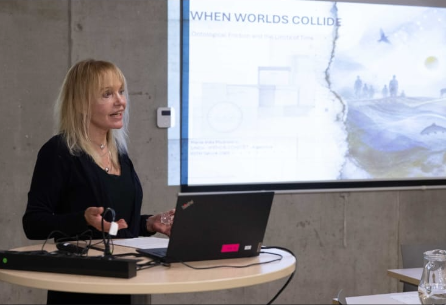
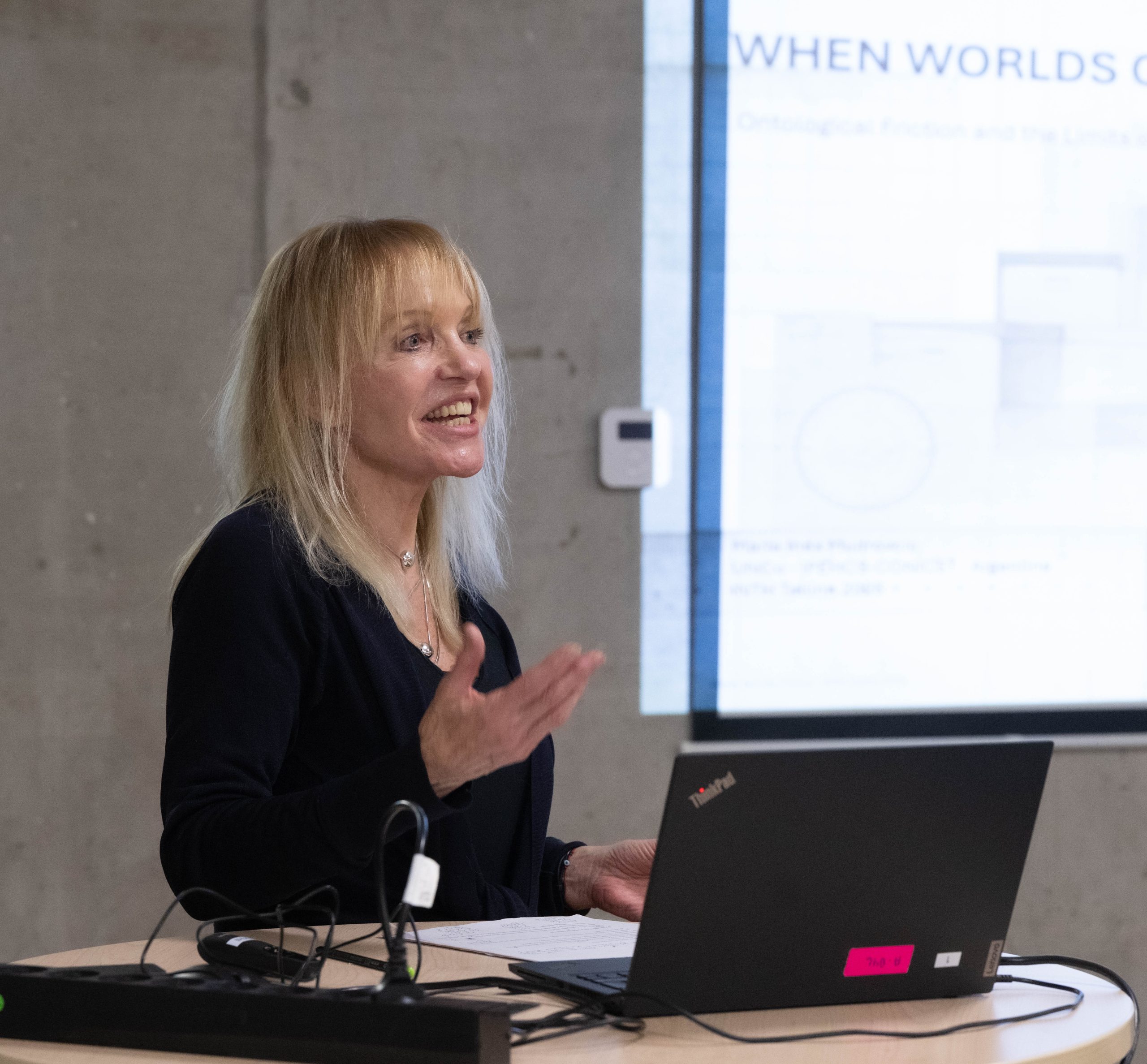
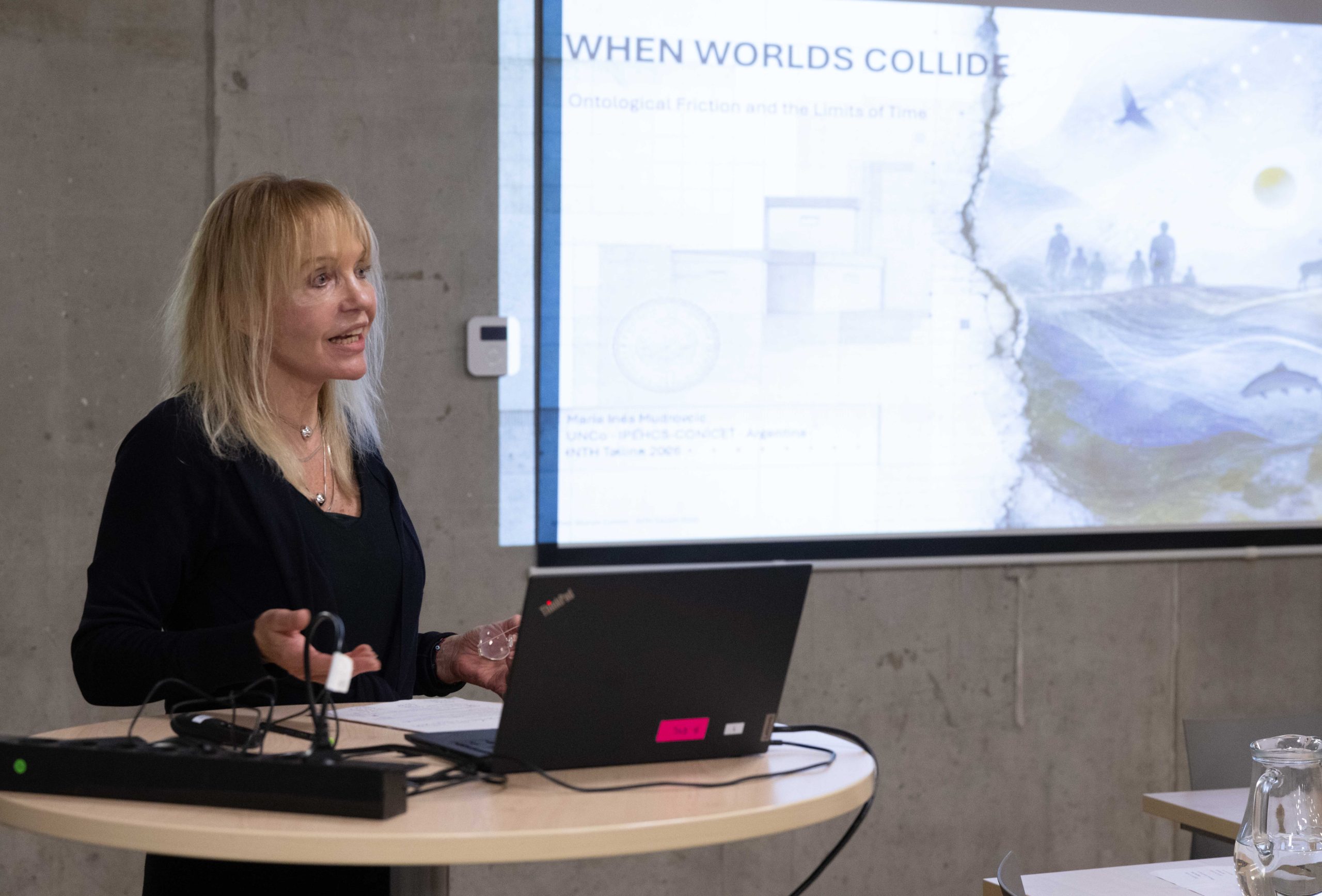
María Inés Mudrovcic
Título: When Worlds Collide: Ontological Friction and the Limits of Time
Resumo:
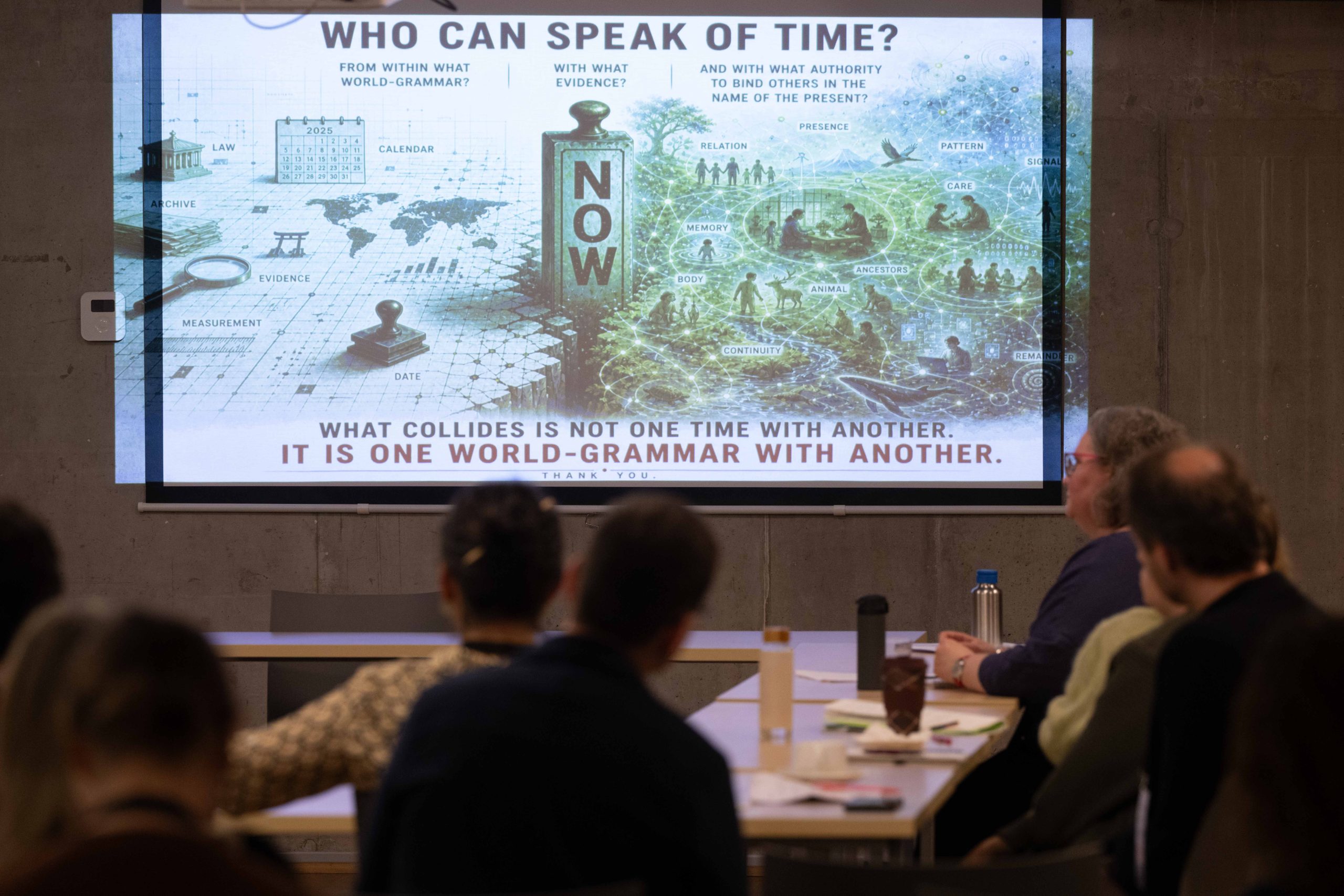
This paper interrogates the very grammar that makes the category of “time” thinkable. My claim is that the widespread language of “multiple temporalities” is not an adequate response to current ontological dislocations. Rather than acknowledging radical difference, it translates other worlds into the substantialist grammar of the West, where “Time” exists as an abstract, noun-like container in which events are located. To speak of “temporal plurality” already presupposes the universality of “Time itself”—a presupposition that erases those worlds in which nothing resembling “time” exists at all. I propose instead the concept of “ontological friction” to describe encounters where incommensurable grammars collide without the possibility of neutral translation. Ontological friction foregrounds asymmetry and violence, refusing to conceal them beneath the reassuring vocabulary of plurality or commensuration. This perspective reframes struggles over temporality not as disagreements within a shared horizon, but as conflicts between different worlds. Two cases exemplify this claim. The first is the marco temporal in Brazil, which legally restricts Indigenous territorial rights to lands occupied on October 5, 1988. By inscribing ancestral relations into a linear chronology, it renders them unintelligible within the legal framework, forcing them into a substantive temporality that denies the relational ontology in which territory, community, and cosmos remain inseparable. The second case is the emergence of artificial intelligences, which gesture toward a form of agency without time, memory, or world. If Indigenous ancestrality resists translation into Western time because it is grounded in relations, AI resists because it may be gestating an ontology without relationality at all. In both instances, we confront not “other temporalities,” but the limits of temporality as a universal category. By situating these conflicts within the broader problem of historicity, I argue that debates must abandon the comfort of plurality and face the political and epistemic implications of untranslatability. Historicity emerges not as a shared human condition but as the contingent and conflictual negotiation of ontologies in friction. Such a rethinking requires us to move beyond the assumption of common temporal frameworks and to confront the irreducible tensions that arise when incommensurable grammars meet.
Miranda Bonfil
Título: Apocalyptic Temporalities in the New World
Resumo:
As the Spanish Crown extended its dominion over the New World, the apocalyptic tradition underwent a twofold transformation. On one hand, events surrounding the Conquest of the Indies were processed through a prophetic lens, which fueled the imperial imaginaries and transformed them into concrete theological-political projects. On the other hand, once the mission process started in (what came to be called) New Spain, the task of explaining the structure of salvation history to indigenous audiences sparked a reconfiguration of ideas regarding the time of the end. For this reason, inquiring into the conformation of a new temporal order in America requires keeping track of two intertwined questions: What did the apocalyptic temporality do to the New World? And what did the New World do to the apocalyptic temporality? While in Mesoamerican traditions, conceptions of the future afterlife were independent from the moral order, the temporal structure of the Christian myth introduced a new system of hierarchical relations between times, in which the promise of the future simultaneously carried the fruits of redemption. With the End presented as the ultimate horizon for human experience, and salvation or damnation depending directly on the moral conduct of the individual, a new, Indo-Christian religiosity was born. This shift mediated the disintegration of traditional Mesoamerican modes of temporal existence, providing alternative frameworks of intelligibility grounded in Christian eschatology. To approach the questions outlined above, I will explore the premise that the transportation of the apocalyptic tradition not only delivered a set of mythical narratives regarding the end of time, but also introduced new ways of negotiating temporal relations with the purpose of strengthening specific theological-political programs.
Eschatological narratives can be, for this reason, regarded as cultural techniques mobilized by different actors for different political purposes. By producing new horizons of historical meaning at moments of profound civilizational disruption, the various versions of the narrative regarding the Last Days and the coming of the Heavenly Kingdom offered the promise of solace and ultimate resolution, while simultaneously creating effective mechanisms of control over the recently converted. As a fundamental step in the formation of a globalized temporal order, this paper explores the political implications of two versions of the apocalyptic tradition in New Spain —one Augustinian and one Franciscan— with their respective versions of pastoral care. By discussing these particular variants, it aims at contributing to broader discussions on the functions of eschatological narratives as cultural techniques, showing that they operate (then and now) not only as instruments of subjection but also as mechanisms for creative reconfiguration of social and temporal imaginaries.
Moira Pérez (University of Buenos Aires / CONICET)
Título: “Making Argentina Great Again” and the Chronopolitics of the Far Right
Resumo:
The global advance of the far right is receiving increasing attention from theories and philosophies of history, particularly concerning disputes over memory and denialism, the construction of a glorious remote past, and the configuration of present antagonisms through the reinforcement of historical ones. In Argentina, continuities and changes in relation to previous progressive administrations have been central to the analysis of the rapid growth of the far-right movement, led by current Argentine President Javier Milei and his political party La Libertad Avanza. This presentation will focus on the chronopolitics that underpin the public discourse produced by Milei: the links he establishes between politics and time and his uses of these figures, including his historical narratives and his representations related to past, present and future. Based on an analysis of the public speeches given by the president throughout 2025, three hypotheses will be deployed. First, that chronopolitics occupies a fundamental place in the libertarian’s argumentation, in his ways of legitimizing his political project, summoning adherents, and differentiating himself from the opposition. Secondly, far from prevailing diagnoses of contemporary presentism, this political project brings forth a radical and absolute rejection of the present, which is practically extinguished between the past(s) and the future. Thirdly, the presentation will show how the future, sustained by the discourses of “making Argentina great again”, represents Milei’s greatest hope and his preferred chronopolitical tool to propel his political enterprise.
The Argentine case presents a unique scenario: while it participates in global trends of the far right’s “culture wars”, its ideological foundation is not always presented as conservative, nor is it built on political or economic nationalism. Instead, its politics may be understood as future-oriented, and it pursues the reinforcement of the country’s position within a neocolonial geopolitical (and chronopolitical) distribution. Theoretically, this presents specific challenges, as analyses produced in contexts of far-right nationalism may not serve as adequate references. Given the transnational circulation, replication and reinvention of far-right discourse, it is imperative to develop situated theoretical tools to understand and confront this phenomenon with its continuities and differences: not only their ways of doing politics, but also the social scenario they help to generate and the historical consciousness that is being forged along with their global expansion.
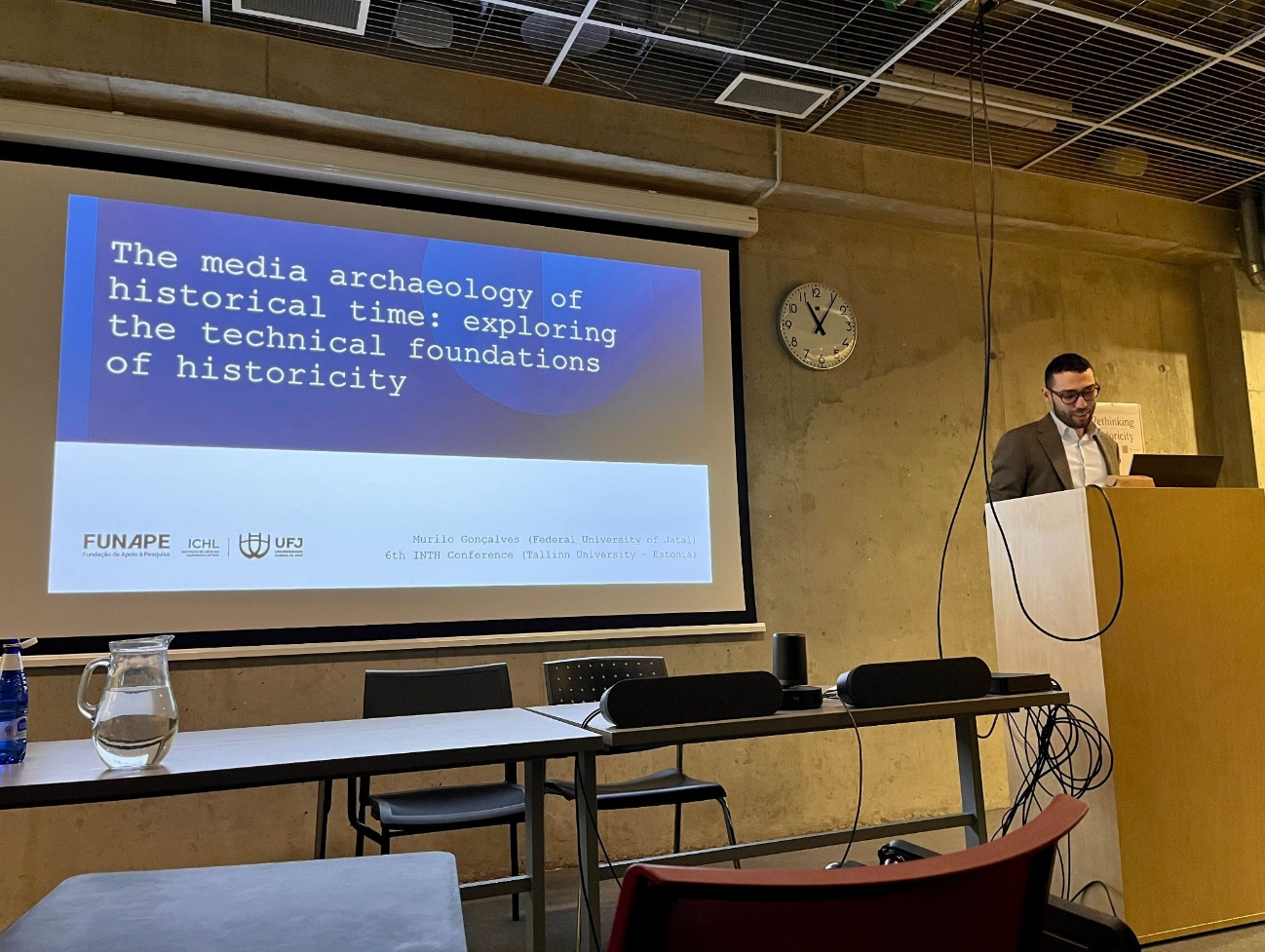
Murilo Gonçalves
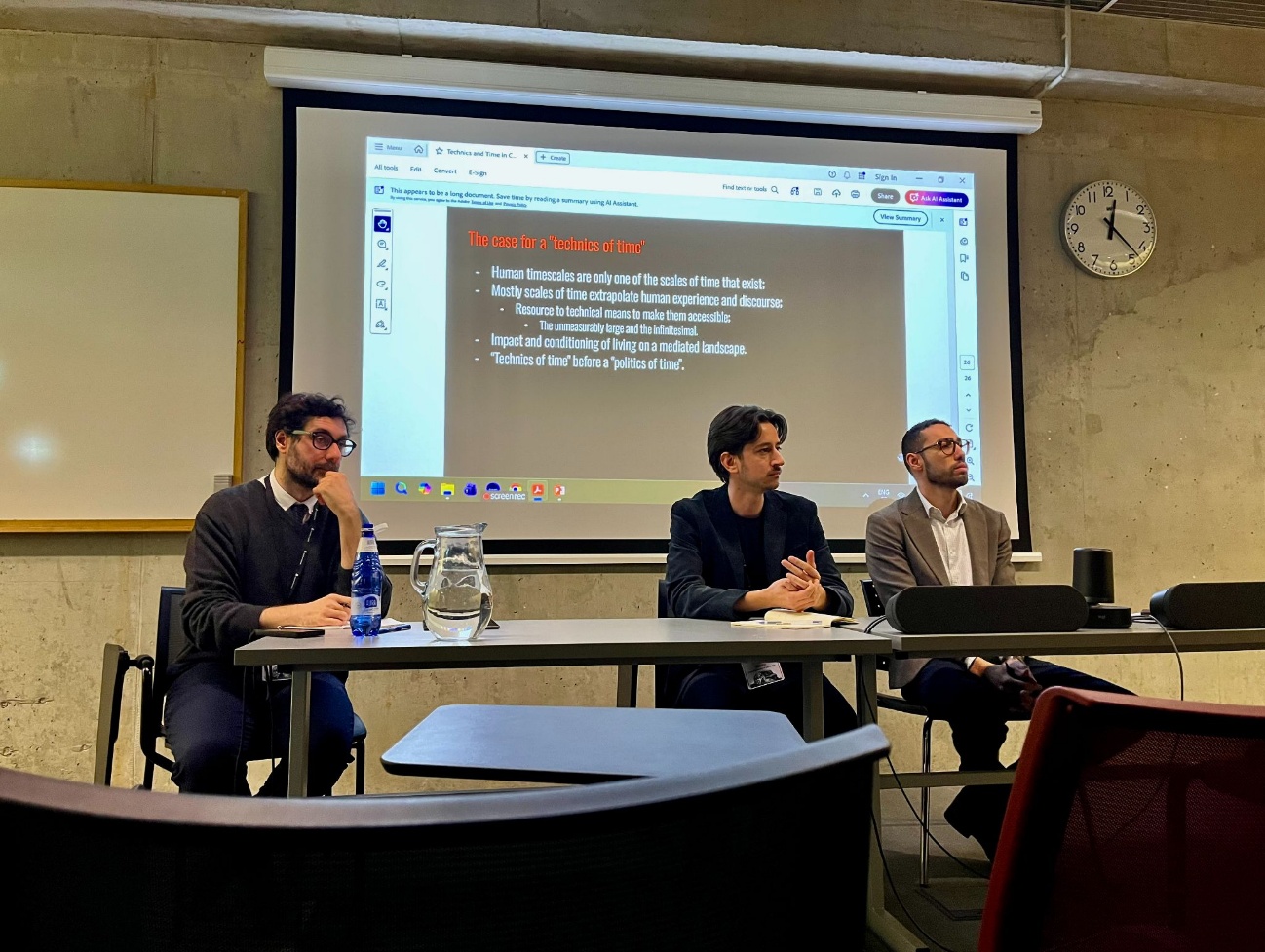
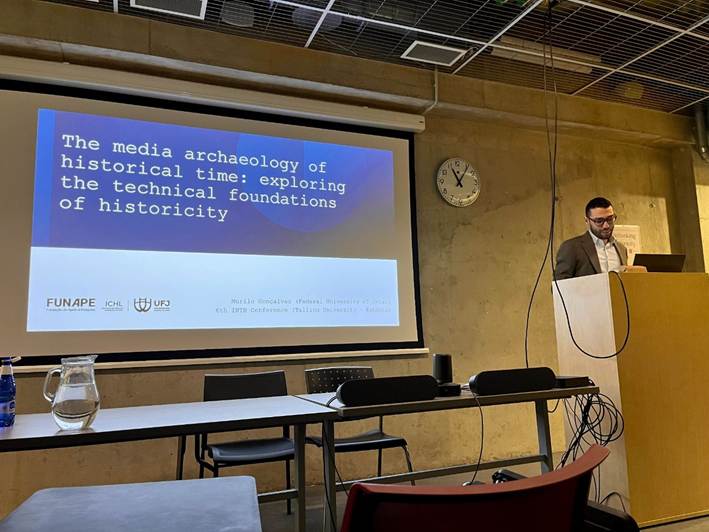
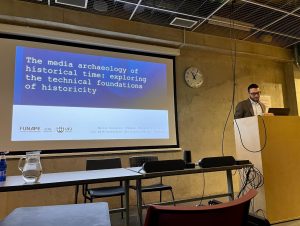
Título: The Media Archaeology of Historical Time: Exploring the Technical Foundations of Historicity
Resumo:
Historicity occupies a central place in modern reflections on historical theory. It is one of the key notions underpinning the modern concept of history, developed between the late eighteenth and early nineteenth centuries, as it refers to the specific nature of the perception of a reality and a temporal experience that are henceforth characterized as “historical”. This conceptualization was grounded, broadly speaking, in the contributions of historicism, hermeneutics, and phenomenology. This long tradition was further elaborated in the second half of the twentieth century and, more recently, has been reexamined in attempts to (re)establish a theory of historicity, that, in some cases, is conceived as a theory of historicities. My presentation seeks to contribute to this ongoing discussion by problematizing the relationship between historical theory and media theory, with the aim of questioning the technical foundations of historicity. It seems crucial to address themes such as historicity within historiographical practice while recognizing that our experience of time, our perception of historical reality, and its representation are increasingly shaped by technically mediated processes. To explore this, I will draw on media archaeology. Media archaeology approaches history primarily as a process of storing, transmitting, and processing information. History is thus determined by its mediality, that is, by its condition as a medium that makes historical practices and phenomena possible in the first place. Mediality, considered in its materiality and exteriority, is what interests media archaeology. In other words, it seeks to clarify the rules and technical conditions of possibility for the emergence of concepts and disciplines. It is within this framework that I intend to examine the concept of historicity. In Friedrich Kittler’s media archaeology, the emergence of historicity as a concept appears to coincide with the rise of a new Discourse Network (Aufschreibesystem), marked above all by the monopoly of print culture. Similarly, the rupture of the modern concept of history, grounded on the homogeneous and linear time of progress, seems to arise in connection with new technologies of inscription for writing, image, and sound at the beginning of the twentieth century. If historicity emerged in the nineteenth century within the conditions of print culture, what becomes of this concept in light of the technological shifts of the twentieth century, and, later, with the advent of digital computing at the turn of the twenty-first? How new forms of connectivity and simultaneity through the internet, as well as algorithmic transformations performed by artificial intelligence reshape our temporal experience? In other words, how can we think not only of multiple historicities, but also of their entanglement with other technical temporalities? These are the questions my presentation seeks to address.
Patto Sá Mota
Título:
Resumo:
In April 1964, a coup d’etat established a military dictatorship (1964–1985) in Brazil that targeted historiography and historians, provoking exile, dismissals and the reinforcement of traditional history. After full democratization by the end of the 1980s, Brazilian historiography experienced a phase of renewal and creativity, dialoguing with global historiographical trends. By the beginning of the twenty first century, state authorities have formulated policies to open archives and encourage research on topics such as the history of black and indigenous peoples. In addition, Rousseff’s government established in 2012 an official Truth Commission to investigate state violence during the military dictatorship.
These democratic initiatives in the field of history have become a target of conservative forces since the right-wing turn that took place in Brazil from 2013, a phenomenon of global scale but with local particularities – such as, in Brazil, the cult of militarism and a distorted memory of the dictatorship. Authoritarian initiatives began even before Bolsonarism, such as the “Schools without Party” (Escola sem Partido) movement, whose main targets were history teachers accused of using Marxist categories in classrooms. Attacks on historians considered progressive, generically called “communists,” intensified after Jair Bolsonaro’s rise to power (2019–2022). He increased authoritarian initiatives such as threats to historians and censorship of school education, while encouraging the dissemination of conservative versions of Brazilian history, especially regarding the period of the military dictatorship. In the panel, I will present a summary of repressive actions against historians (arrests, dismissals, torture, censorship, trials, harassment) during the past dictatorship and the Bolsonaro years, highlighting some exemplary cases. Beyond that inventory, I intend to analyze the objectives and motivations of such attacks (that may be considered a kind of “history war”) and their impact on the community of Brazilian historians.
Pedro Eduardo Silva
Título: A Misleading Portrait: Re- examining R.G. Collingwood’s Critique of the Relationship Between the Science of Human Nature and History in David Hume
Resumo:
Even though R.G. Collingwood recognized many of David Hume’s achievements while elaborating on the relationship between the science of human nature and history, most of Collingwood’s evaluations of Hume’s method tended to reproach it as non-historical. This is not a novel perception, since part of the literature on Collingwood’s reception of Hume has repeatedly stressed this fact. In general, scholars rightly assert that this happens primarily because Collingwood based his understanding of Hume’s methodology on a series of readings of Book I of the Treatise of Human Nature. Therefore, Collingwood concluded that Hume tended to understand human nature as immutable since its origins. In agreement with the scholarship on Collingwood’s reception of Hume’s philosophy, I also concede in this presentation that the former misunderstood the relationship between human nature and history in the latter’s philosophy. However, I will argue that not only Books II and III of the Treatise and the first and second Enquiries, but also the more historical Essays and, especially, the History of England, advanced a Humean comprehension of human nature as dynamic and mutable over time. The point I will defend is that Hume’s investigations into history, from the 1740s onwards, led him to understand historical agents as enmeshed in a wide variety of situations that shaped their characters, prejudices, and opinions. I will also argue that Hume’s historical reflections highlighted that specific historical structures directly shaped human nature, and that this perception led him to reframe the methodology of his science of human nature to the point that it became an effective tool for grasping those interactions. Ultimately, the presentation will argue that, when read together, some of Hume’s writings developed a more or less coherent scheme to re-enact the dispositions and passions of historical agents, anticipating aspects of later theories of understanding of the subjective experiences, thoughts, and values that motivate human actions.
Pedro Henrique Batistella
Título: Media events and historical culture: an analysis of the celebrations of the anniversaries of the founding of nationality in the New Republic in Brazil (2000/2022)
Resumo:
The production of commemorative language about the Nation’s founding dates is a historical phenomenon raised mainly after the eighteenth century. Entangled through historical narratives and ritualistic practices, the national commemorative language is set up by national states, and, for that reason, they reproduce the historicist ways to experience the relations between past, present and future. Considering that it particularly arranges connections between a foundational historic event and the present momen t, the main effect produced is a legitimation of the nation’s trajectory as a natural progression. I understand that temporal structure from the analytical perspective developed by Berber Bevernage (2018), which is based on the concept of ‘politics of time’. The use of this concept makes it possible to grasp the relationship between historicity and national commemorative language, as to verify how commemorative events construct specific performative modes of engagement with the time. As stated by Vera Simon (2008), it can be synthesised as: 1. the production of a pause in time through the declaration of holidays; 2. the production of narratives that stress the continuities between past events and the present time; 3. the summoning to celebrate a t national community. Nevertheless, the relationship between historicity and commemorative language also requires verification in light of their media dimensions, which shape the contemporary mediatized societies. In this sense, commemorative events may be understood as media events , as argued by Espen Ytreberg (2023). I use those theoretical definitions as starting points to verify the semantics and historical condition of the commemorative language, concerning the foundation of the Brazilian people and the foundation of the Brazilian State, from two specific events: th e Fifth Centennial of Brazilian Discovery which happened in 2000, and the Bicentennial of Brazilian Independence in 2022. The aim of this presentation is to expose the preliminary results of my current PhD research, which interrogates commemorative languag e in two dimensions: the role of media in public space and the ethnic and racial conflicts in the current Brazilian society. From this, the presentation is based on two main research sources: the television broadcast of the Mass for Brazil’s 500th anniversary and the online broadcast of the presidential parade for Brazil’s 200th anniversary of Independence. On the one hand, it will be exposing the common aspects of two events concernin g the use of media technologies. As I will explain, television and digital platforms do not function just as channels to spread events and their languages, but the media predetermines the conditions of events happening. On the other hand, I will describe the social and political dimensions of the commemorative practices and discourses disputed by indigenous people, in the first case, and the pronunciation of discriminatory discourses by far -right groups, manifested in the second case.
Pedro Spinola Pereira Caldas
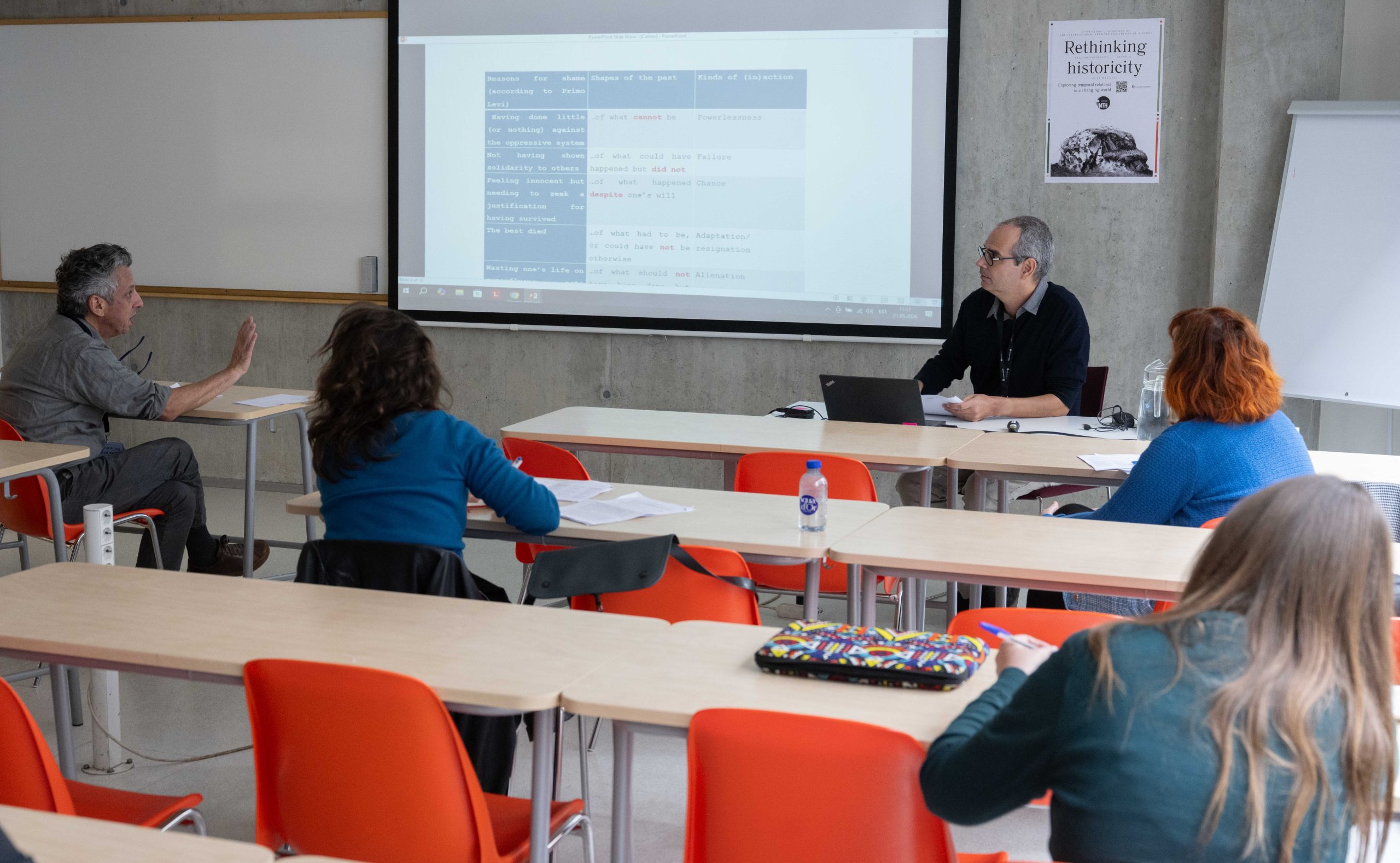
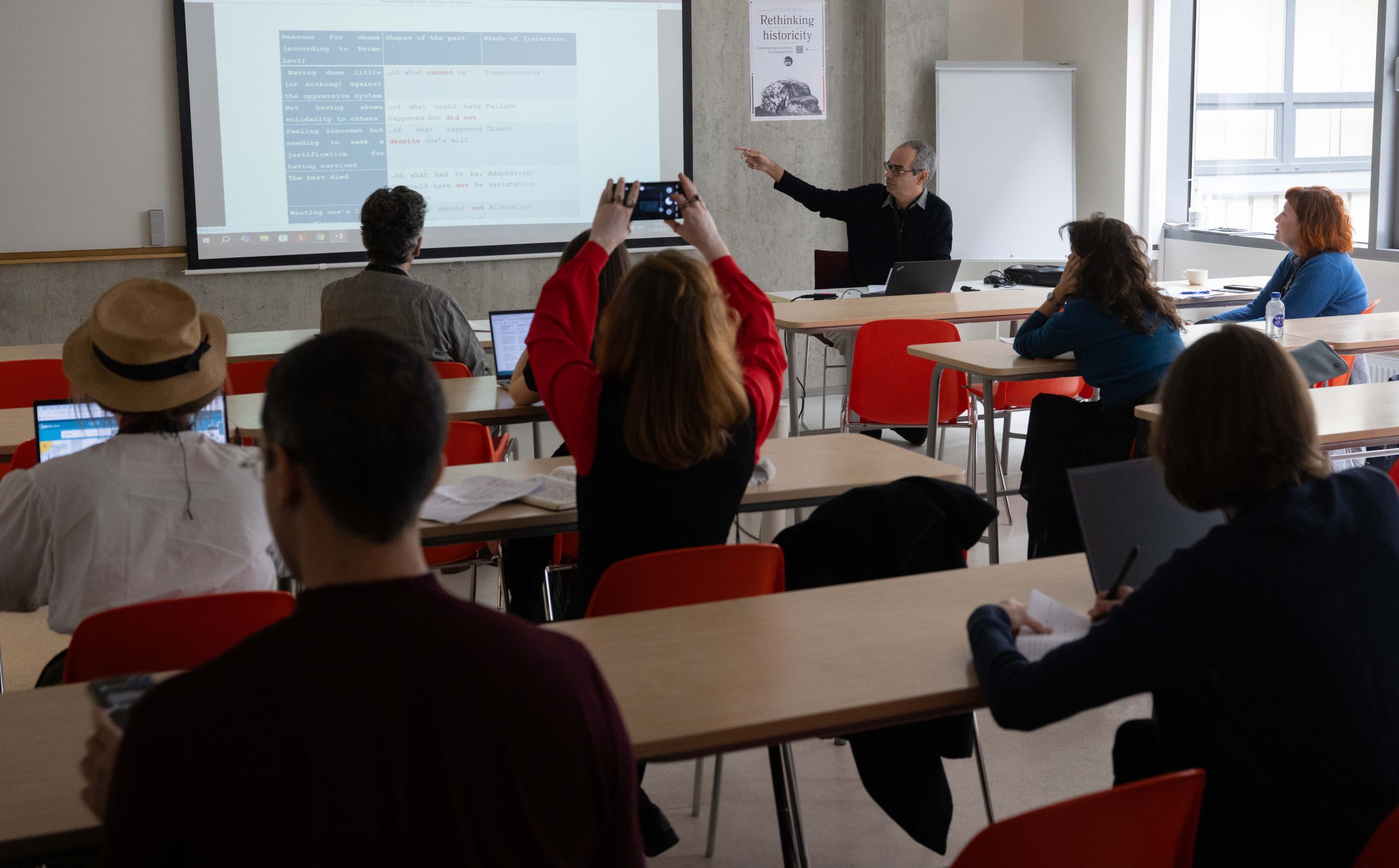
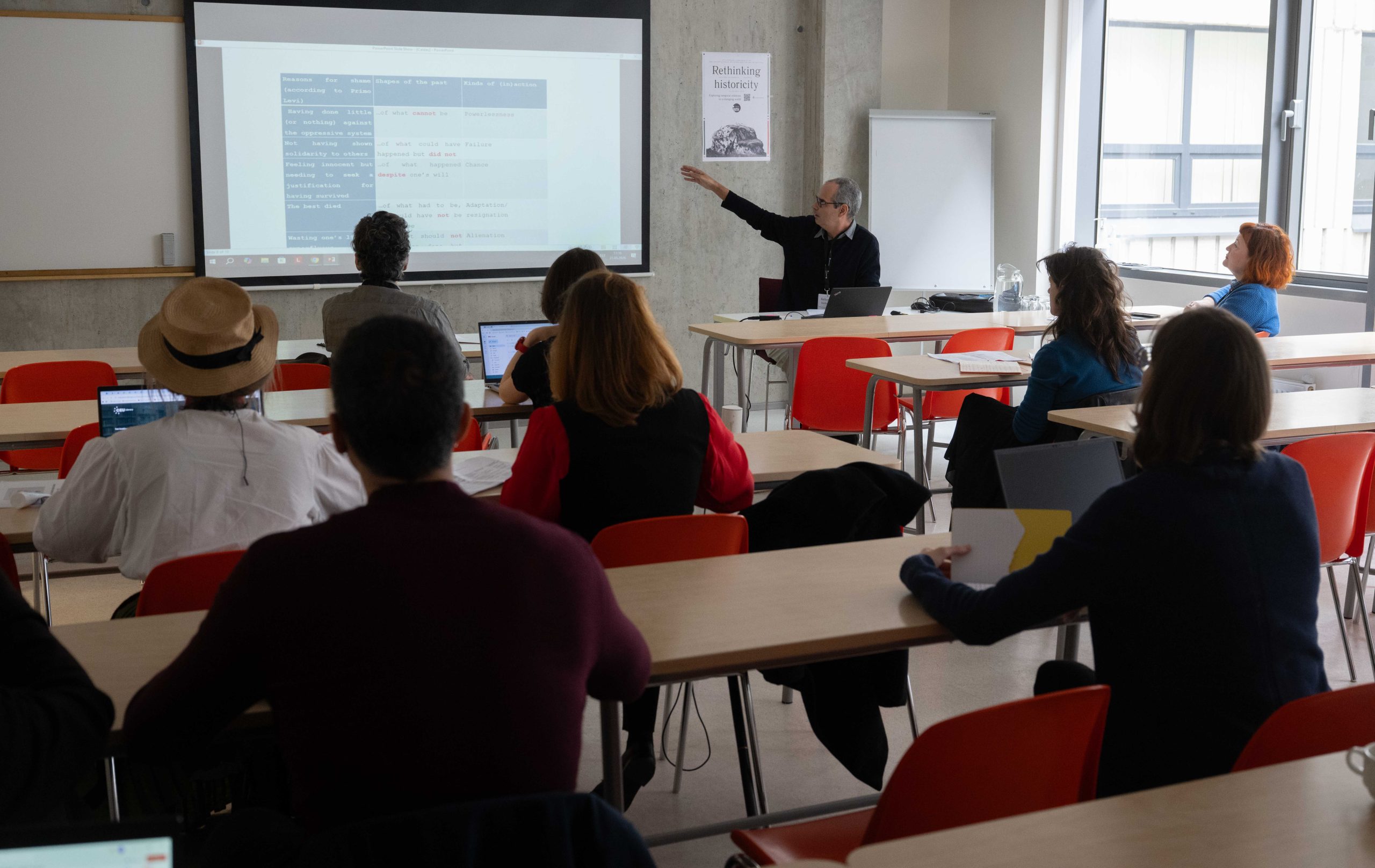
Título: Primo Levi’s Late Style: The Historicity of Shame
Resumo:
This paper is intended to discuss the historicity of the survivor in Primo Levi. I thus propose to understand shame as a form of “encounter with historicity” , to use the expression employed by François Hartog in Regimes of Historicity (used here as a point of departure, not as an analytical category to be applied normatively). My analysis focuses on Primo Levi`s The Drowned and the Saved (1986) to discuss the implications of the metacritique of testimony proposed by Levi himself. This metacritique demarcates a paradox: on the one hand, Levi maintains his critical effort to detect stereotypes. We can identify at least two of them: (a) the stereotype of idealization (of the survivor’s heroic behavior ) and (b) the stereotype of overcoming (imposed by the survivor’s supposed need to feel free after liberation). The task of testimony thus becomes even more significant, but not without challenges (beyond these external ones ), since: (a´) the stereotype of idealization attempts to oppose a reconstruction of the (im)possibilities of action, although this same reconstruction can be stopped by the impasse between what he calls “decantation” and “stylization” and (b´) Levi attempts to oppose the stereotype of overcoming with the experience of shame , that is, the negative side of the public experience of exposure. Based on the reconstruction of Levi`s analysis of four forms of shame, I`ll try to show how Levi`s “encounter with histor icity” is plural and complex, thereby pointing to a critique of any form of conciliation between past and present. Having expounded on these impasses, the question remains : is it possible to understand shame based on the concept of “late style” created by Theodor Adorno in his analysis of Beethoven’s final works ? And is this “late” thus not a way of experiencing an “encounter with historicity”?
Pedro Telles da Silveira
Título: Technics and Time in (Counter)Forensic Practice
Resumo:
The relationship between historical knowledge and forensic practice is not entirely novel, but it was significantly reconfigured during the late 1970s and 1980s, particularly with the emergence of memory claims and the development of transitional justice. These developments catalyzed the formation of an international humanitarian system grounded in investigative methodologies, including the location and identification of victims of conflict and violence. Such approaches place growing emphasis on material evidence, such as bodily remains, as well as the physical consequences of human rights violations on both built and natural environments. By adopting this investigative orientation, human rights advocacy has developed itself into what is called the “forensic turn”. A salient feature of the forensic turn is its privileging of material evidence, which is central to investigative processes. However, to make material evidence “speak”, its is necessary to assemble interdisciplinary teams comprising experts in fields such as archaeology, physical anthropology, biology, chemistry, architecture, engineering, and data science, alongside the deployment of specialized techniques and analytical instruments. Thus, human rights practice under the forensic turn is a highly interdisciplinary approach. Additionally, under the forensic turn, human rights advocacy is also a technology, media-dependent practice. This shift is premised upon the understanding that images are integral not only to disseminate information and to attribute responsibility in a polarize media environment, but also to shape the conduct and the investigation of conflicts themselves. It is within the scope of this practice’s relationship to historical knowledge and the role of technics that this presentation is premised upon. By analyzing four examples of this practice — the investigation of the killing of Mark Duggan by the London police force in 2012 and the Grenfell Tower fire in 2017, both investigations conducted by Forensic Architecture, a human rights advocacy group founded by British-Israel architect Eyal Weizman, as well as the work of Acervos Digitals, based in Brazil, regarding the attempt coup of January 8th 2023, and the world of research group DejaVu on the field of event recognitions —, the goal is to understand how temporality is subjected in these investigations to a series of different techniques and procedures that turn time into an operational category.
Those four investigations are based upon the collection and analysis of footage recorded by security cameras and witnesses of the events to which they are related. Additionally, the investigations are presented in elaborate data visualizations that employ a range of techniques, including the timestamping of visual evidence, synchronization of visual evidence, and 3D modeling. These methodologies, which are based upon digital media and, therefore, as Wolfgang Ernst remarks, are “time-critical”, having time as one of its fundamental characteristics, show that, in current forensic and counterforensic practices, socio-historical and technical temporalities are entangled. Therefore, in these investigations, temporality is subject not only to a politics, but also to a technique of time.
Ricardo Ledesma Alonso
Título: A Modernist Concept of Mexican Times: Samuel Ramos’ El perfil del hombre y la cultura en México (1934)
Resumo:
INTH Conference “Rethinking historicity: exploring temporal relations in a changing world” (Tallinn University, 19 to 22 May 2026) Ricardo Ledesma-Alonso Faculty of Philosophy and Letters Universidad Nacional Autónoma de México ricardoledesma@filos.unam.mx Title A modernist concept of Mexican times: Samuel Ramos’ El perfil del hombre y la cultura en México (1934) Abstract Mexican philosopher Samuel Ramos’ El perfil del hombre y la cultura en México (1934) is frequently conceptualized as an “sketch” of Mexican history constructed from a hodgepodge of theoretical and formal resources (Romanell 1975; Hurtado 2012; Houvenaghel 2014). Ramos’ unsystematic recurrence to biological language and to analytical categories of Adlerian psychology, both used to explain the historicity of “Mexican soul” and its “neuroses” (its inferiority complex), coupled with his subjective, fragmentary, and ironic essayistic discursive style, had led scholars to assume El perfil… as a late and odd example of pre-professional writing of history in Mexico. In contrast to these interpretations, which end up assessing Ramos’ book only for having inaugurated the inquisition for national identity called “philosophy of the Mexican”, this paper considers its sui generis epistemic and aesthetic features as an expression of a shift in perception of temporality as experienced by avant-garde intellectuals in the 1920s and 1930s pos-revolutionary Mexico. Opposing the progressive, teleological and essentialist schematizations of Mexican history, both of positivist – i.e. Emilio Rabasa’s – and national-revolutionary – i.e. José Vasconcelos’ – historical discourses, Ramos recognized the simultaneity of heterogeneous strata of social time structuring national history – i.e., the coexistence of traditional and modern attitudes in Mexican urban society; or the corsi and ricorsi identifiable in its social and political processes –. In my view, Ramos’ nonlinear, slippery, looped concept of historical time, found precisely its correlate in the epistemological and aesthetic elements that constitute
Ricardo Ledesma Alonso
Título: A modernist concept of Mexican times: Samuel Ramos’ El perfil del hombre y la cultura en México (1934)
Resumo:
Mexican philosopher Samuel Ramos’ El perfil del hombre y la cultura en México (1934) is frequently conceptualized as a “sketch” of Mexican history constructed from a hodgepodge of theoretical and formal resources (Romanell 1975; Hurtado 2012; Houvenaghel 2014). Ramos’ unsystematic recurrence to biological language and to analytical categories of Adlerian psychology, both used to explain the historicity of “Mexican soul” and its “neuroses” (its inferiority complex), coupled with his subjective, fragmentary, and ironic essayistic discursive style, had led scholars to assume El perfil… as a late and odd example of pre-professional writing of history in Mexico. In contrast to these interpretations, which end up assessing Ramos’ book only for having inaugurated the inquisition for national identity called “philosophy of the Mexican”, this paper considers its sui generis epistemic and aesthetic features as an expression of a shift in perception of temporality as experienced by avant-garde intellectuals in the 1920s and 1930s pos-revolutionary Mexico. Opposing the progressive, teleological and essentialist schematizations of Mexican history, both of positivist and national-revolutionary historical discourses, Ramos recognized the simultaneity of heterogeneous strata of social time structuring national history – i.e., the coexistence of traditional and modern attitudes in Mexican urban society; or the corsi and ricorsi identifiable in its social and political processes –. In my view, Ramos’ nonlinear, slippery, looped concept of historical time, found precisely its correlation in the epistemological and aesthetic elements that constitute El perfil…: 1. in its vitalist-historicist cognitive point of view, aimed at the posing of hypotheses about the historicity of the heterogenous components of the Mexican vital process; 2. in its abandonment of the real-mimetic narrative model in favor of a type of discourse that, like the essay, places the emphasis on showing, not so much what phenomena are as such, but on the multiple tools and perspectives that can be employed by the cognizant subject in order to address their complexity. I call here – preliminarily – “modernist” the kind of historiography practiced by Ramos, due to the links it had with the anti-mimetic ontological, theoretical and aesthetic principles of contemporary Atlantic modernist culture (Jameson 1985; White 1999; Assis 2023; Alonso 2024), which in Mexico was exemplified by the discursive products of the members of the vanguardist intellectual group Contemporáneos (Sheridan 1985; Franco and Stanton 1994). Ultimately, this proposal aims to contribute to the current debates on history of the ontologies of temporality underlying Ibero-American historical representations during the first half of the 20th century.
Rodrigo Bragio Bonaldo
Título: Historicity as a Cosine Difference? Metaphors, Models, and Temporal Relations
Resumo:
Historiography has long reflected on how technologies of inscription – from chronicles and archives to photography and film – reshape temporal experience. Today, algorithmic infrastructures amplify this tension: AI models discretize the past into vectors, embeddings, and parameters that promise to synchronize heterogeneous presents. This paper situates these developments within t he INTH theme of Temporal Relations, asking how the “time of the machine” and the “time transformed by the machine” alter our historicities. The argument revolves around a tension Ethan Kleinberg (2025) describes as the pull between “temporal vectors” – the contingent irruptions through which the past unsettles the present – and the aspiration to an “ahistorical compass”, which fixes orientation across time. McKenzie Wark’s notion of vectoralism sharpens this dilemma by framing infrastructures as systems that extract, circulate, and normalize data flows. Read together, they invite us to see algorithmic models not merely as technical tools but as normative devices that mediate historical time. Against this backdrop, I introduce Me taphorique as a reflexive probe to think with and against these transformations. Developed within the AI & History project at the Federal University of Santa Catarina, Me taphorique is a large-scale language model designed to identify and analyse metaphors in diachronic corpora. Its dataset is built from Javier Ferna ndez Sebastia n’s Key Metaphors for History (2024), with metaphors annotated according to his classifications. The project thus combines hermeneutic traditions with automated processing of large textual collections. In the field of NLP, Me taphorique addresses the classic challenge of metaphor detection, adapting advances in MelBERT and retrieval-augmented generation (Choi et al. 2021; Lewis et al. 2021; Lin et al. 2024) to trace semantic trajectories of historical concepts. Its design emphasizes contingency: by surfacing recurrent patterns alongside outliers, it exposes how models discretize duration while revealing what resists synchronization. The contribution lies less in technical performance than in the epistemological and ethical stakes it makes visible. I argue that the central risk of our present is not an excess of data but an excess of models. Models simplify, project regularities, and erase deviations; their proliferation saturates reality with schemas that claim to organize and update it. Me taphorique is presented as a lens to interrogate these dynamics and to ask how historiography might preserve the openness of temporal relations without succumbing to a single normative compass. CHOI, Minjin et al. MelBERT: Metaphor detection … In: Computational Linguistics: Human Language Technologies, pp. 1763–1773, 2021. FERNÁNDEZ SEBASTIÁN, Javier. Key metaphors for history : mirrors of time . New York: Routledge, 2024. LEWIS, Patrick et al. Retrieval -Augmente Generation for Knowledge -Intensive NLP Tasks. arXiv preprint arXiv: 2005.11401v4, 2021. LIN, Yujie et al. A dual -perspective metaphor detection framework using large language models. arXiv preprint arXiv:2412.17332, 2024. KLEINBERG, Ethan. Temporal Vectors and the Compass of History : Politics and Ethics at the End-time. Bielefeld: University Press, 2025. Wark, McKenzie. Capital is Dead: Is This Something Worse? London; New York: Verso, 2019.
Sabrina Costa Braga
Título: Multidirectionality of Memory and Multiplicity of Time: Traumatic Pasts in Testimony
Resumo:
This paper argues that the concept of multidirectional memory can be placed in dialogue with the notion of a multiplicity of time by positioning testimony as a privileged way of accessing a traumatic past. Michael Rothberg considers contemporary multicultural societies as ideal for examining how different narratives of victimization interact in the public sphere. To describe this intercultural dynamic, he coined the concept of multidirectional memory as a process that foregrounds not a direct lineage between remembrance of past and present identity, but rather the formative bonds created through engagement with others’ pasts, even those perceived as foreign or distant. What I argue is that testimony is the prevalent mode of narrating the past that transcends the boundaries of national or group memory, yet simultaneously serves as a site of conflict between historical time and embodied traumatic temporality, thereby disrupting linear narratives. This relation can be illustrated by the fact that the Holocaust has been used as a metaphor or as a platform to articulate other stories of violence that happened both before and after. On the other hand, the public memory of the Holocaust emerged and keeps reemerging in testimonial forms that dialogue with postwar events initially seen as very dissimilar. The constant presence of this past in both historical research and public discourse can be understood as a political choice, but also (and not exclusively) as a manifestation of the temporality of trauma. These two motifs are constantly intertwined. Still, conflicts of memory surrounding the Holocaust are neither rare nor insignificant. These conflicts are often revisited through political uses of memory that connect them to present-day concerns, whether in the urgent fight against forgetting or in the struggle for recognition regarding other genocides. Nevertheless, since the Holocaust, testimony functions as the convergence between the individual task of trauma storytelling and its collective component. The Eichmann Trial marks the moment when the legal witness (testis) and the narrative survivor (superstes) converged, paving the way for the possibility of the history of the victims being told by the victims themselves. If memory is the past made present, what becomes of history when the witnesses, as the bearers of the past, become the public embodiment of history? Since the 1970s, numerous projects have been created aiming to put testimonies into video format. Thousands of testimonies and thousands of hours have been archived. More recently, the New Dimensions in Testimony project presented the possibility of interacting with a hologram of a Holocaust survivor who may no longer be alive, thereby continuously reenacting their presence in the present. To explore this, the paper is structured around a set of questions: how does the non-linear temporality of trauma itself enable the multidirectionality of memory? As the testimonial genre evolves into artificially maintained and politically informed forms, what consequences arise for transnational and transcultural memory dialogues? What are the broader implications when the potential for multidirectional exchange becomes contingent upon technological preservation strategies designed to keep memory “alive” beyond the lifespan of living witnesses?
Sara Vinter Schmitt
Título: Administrateur du bien des décédés: the historian’s task in Jules Michelet
Resumo:
This paper aims to analyze the task of the historian and his duty toward the dead through selected paratexts from the writings of Jules Michelet (1798–1874). Before becoming a historian, Michelet was trained in letters, later establishing himself as teacher, translator, and finally one of France’s most influential historians. This study focuses on several of his prefaces, where he reflects on the ethical and existential responsibilities of the historian. Central to this reflection is a particular sense of historicity, in which the historian moves constantly between the living and the dead. The central source is the preface to Volume II of Histoire du XIXe siècle, published posthumously in 1875. There, Michelet invokes the figure of the Administrateur du bien des décédés, drawn from the portuguese poet Camões, to define the historian’s task: the historian is like a magistrate entrusted with exhuming and restoring the legacies of the dead. History, he writes, “welcomes and renews these disinherited glories; it gives a new life to these dead, resurrects them. […] Thus is formed a family, a common city among the living and the dead” (Michelet, 1880, p. 7). This metaphor is used before in the famous preface to Volume XIX of Histoire de France (1869), where Michelet declares: “This title, this responsibility, belongs to the historian. I will not prove unworthy of it, I will pay these debts and will not die insolvent” (Michelet, 1876). Here, the historian is imagined as a perpetual debtor to the dead, lending his own life to administer, resurrect, and restore them. Yet, as François Hartog observes, this “resurrection” must not be understood as making the dead live again, but as disclosing their truth in the past – granting them meaning beyond what they could know themselves (Hartog, 2005). This work requires a demanding labor of writing: not merely narrating events, but giving voice to silences, “those terrible culminations where history itself remains speechless, and which are precisely its most tragic expressions” (Michelet, 1959, p. 378). Such an effort involves not only exhuming the forgotten but listening to the unspoken, thereby making history truly “alive.” A crucial question arises: whom must history resurrect? In his Journal, Michelet writes, “Of what is history made, if not of me?”. Years later, in Le Peuple, he expands this reflection: “But I loved more. I also suffered more. The trials of childhood are always present to me; I kept the impression of labor, of a harsh and toilsome life; I remained the people” (Michelet, 1846, p. 35). Ultimately, the historian’s debt is directed above all to the people. The historian must listen to them and acknowledge them as actors of history (Michelet, 1989). In this sense, Michelet’s conception of historicity situates the historian between the living and the dead, charged with mediating temporal relations through writing. By assuming the role of administrator of the dead’s legacy, the historian both acknowledges an infinite debt and reconfigures the boundaries between past and present, making history an ethical act of remembrance and restitution. References MICHELET, JULES. Préface à Histoire de France, parue dans le tome XIX : Histoire de France 1758-1789, éd. augm., Paris, Lacroix et Cie Editeurs, 1876. MICHELET, Jules. Histoire du XIXe siécle. Paris: C. Marpon et E. Flammarion, 1880. MICHELET, JULES. Journal. Paris, Gallimard, 1959. MICHELET, JULES. Le Peuple. Paris, Hachette, 1988. HARTOG, François. Évidence de l’histoire – Ce que voient les historiens. Paris, Éditions de l’École des Hautes Études en Sciences Sociales, 2005
Sofia Sell
Título: Museum and Time: connections between museal narratives and the presence of the past
Resumo:
This paper aims to understand how the history museum outlines historical times. As Peter Osborne (1995, p. 200) asks: “How do the practices in which we engage structure and produce, enable or distort, different senses of time and possibility? What kinds of experience of history do they make possible or impede? Whose futures do they ensure?” Considering Osborne’s questions, the objective is to understand how the museum as an institution relates to multiple temporalities and experiences of time, highlighting or making invisible, including or excluding, in order to construct ideas of past, present, and future. The processes and practices carried out by museums cannot be understood as existing in a vacuum, devoid of value and intention. The acquisition of items, the production of exhibitions, and the construction of narratives are driven by motivations and purposes that carry within them values, priorities, desires, and positions that, while not always explicit, define the paths taken and the decisions made by these institutions. There are infinite ways to assign meaning to an object and integrate it into an exhibition, just as there are infinite ways to construct narratives and exhibitions. However, all of them, without exception, are based on specific notions of time, allocating the groups to which the items relate to to different periods, divided by boundaries performed in different ways and organized based on different interests, through the narrative built around the objects on display and the meanings attributed to them. Thinking about the role of museums in society, then, inevitably involves considering the ways in which they relate to the temporalities of that society; it is necessary to analyze how the past becomes present, how the future becomes present, and how the past becomes future, but also how and why certain pasts do not become present and certain presents do not become futures. By operating in time, social actors define their collective memories and their shared pasts, constructing their collective identities and their shared presents in the present. By assigning meaning to the past and the present, the future projects to be executed are settled. If a group has its contemporaneity denied to the present with shared, it has no legitimacy to be included in the possibilities of a shared future project. On the other hand, by claiming its contemporaneity with the shared present, this group also claims its possibilities of existence in the shared future, ensuring the continuity of its identity and memory. Therefore, it is important to emphasize that the politics of time created, reproduced, and maintained by museums do not have ramifications and reverberations only with regard to the perception of the past and contemporaneities in the present; although these are very important dimensions, these politics of time also have consequences for the perception of the future in the present. By operating on time, the museum determines who belongs to the shared past, the shared present, and the shared future. References : BEVERNAGE, Berber. “A passeidade do passado”: reflexões sobre a política da historicização e a crise da passeidade historicista. RTH, v. 24, n. 1, p. 21-39, 2021. MUDROVCIC, María Inés. Políticas do tempo, políticas da história: quem são meus contemporâneos? Rethinking History, v. 23, n. 4, p. 456-473, 2018. OSBORNE, Peter. Epilogue. In: OSBORNE, Peter. The Politics of Time: Modernity and Avant-Garde. Londres: Verso, 1995. p. 197-201. RAMALHO, Walderez. Sobre os limites do tempo: história do tempo presente, policronia e performatividade. História (São Paulo), São Paulo, v. 42, p. 1-22, 2023. DOI: https://doi.org/10.1590/1980-4369e2023036
Taynna Marino
Título: Nonhuman Victims of the Capitalocene: on Empathy and Anthropocentrism
Resumo:
What do we mean when we speak of victims in history, and who is allowed to appear within this category? In recent decades, victimhood has become central to historical narratives of violence and injustice. Historians have recovered the experiences of victims of war, genocide, enslavement, and state repression, often attending to forms of suffering that were previously silenced. Yet the apparent clarity of the term “victim” is somewhat misleading. Not all forms of suffering are equally visible in historical accounts, and not all subjects exposed to harm are recognized as victims. This paper examines the category of victim in the theory of history in light of experiences of suffering that extend beyond the human. It asks under what conditions nonhuman beings can be recognized as victims in the context of the Capitalocene, where processes of extraction, commodification, and accumulation expose both humans and nonhumans to forms of “slow violence.” Drawing on examples from industrial agriculture and scientific experimentation, I show how nonhuman beings, particularly animals, are subjected to systematic violence that remains difficult to articulate within existing historiographical and ethical frameworks. I argue that this difficulty is not only empirical but conceptual: the category of the victim is entangled with anthropocentric assumptions that limit what suffering is legitimate and who counts as a victim. Rethinking victimhood in terms of an ethics of vulnerability rather than of humanity opens the possibility of approaching nonhuman beings as victims without reducing them to human analogies or dissolving differences between species. Within this framework, I propose understanding empathy as a post-anthropocentric method and practice that conditions recognition of nonhuman suffering. Empathy does not provide direct access to nonhuman experience; rather, it reorients the historian’s relation to suffering by making visible forms of violence that exceed the human. In this sense, empathy becomes a condition of possibility for writing histories of nonhuman victims in the Capitalocene.
Thamara Rodrigues
Título: Theory of History and Alternative Temporalities: Re-enchanting the Future
Resumo:
This presentation draws on research conducted at the Universidade do Estado de Minas Gerais and the Universidade Federal de Ouro Preto, Brazil, which investigates modes of engaging with contemporary temporality. Its central aim is to create conditions of possibility for opening alternative ways of relating to time, particularly in view of the potential for a re-enchantment with the future. Analyses in the field of Theory of History emphasize the aggressive presence of pasts and threatening futures, a phenomenon associated with the reduction of imagination about other possible realities. While such diagnoses are important, an exclusive focus on closures risks obscuring the latent openings toward alternative realities within these contexts. Our research suggests that the investigation of temporality should be accompanied by intellectual exercises that value experiences capable of counterbalancing the sense of historical stagnation. This involves the challenge of transforming knowledge about time into a way of acting upon it, promoting intersections between social temporalities and existential experiences of time. The project seeks to produce reflections and practices that re-enchant ways of engaging with the past beyond nostalgia and fetishization, the present beyond entrapment, and the future beyond exhaustion and stagnation. In this presentation, we will highlight reflections and practices developed in the courses on Theory of History and Brazilian Historiography, in which participants from outside the academic sphere are invited to share, write about, and reflect on their individual and communal relationships with time. Such activities have revealed, on the one hand, the persistence of horizon-closure diagnoses, but on the other hand, they have also uncovered fissures that foster the imagination of alternative temporalities in regional contexts. By exploring these fissures, our research seeks to emphasize the possibilities of re-enchanting the future through new collective engagements with time.
Thayran José Ramos
Título: Historical Temporality in Žižek: An Introduction to Temporal Parallax and Anachronism
Resumo:
The concept of parallax is derived from physics and introduced into philosophy by Slavoj Žižek in The Parallax View (2008). The slovenian philosopher borrows the notion of parallax of Kojin Karatani, and, through a critical formulation, establishes his own concept of parallax, based on Hegel, Marx and Lacan. The main objective of this communication is to introduce the Zizekian concept of parallax, demonstrating its transposition from optics and astronomy to temporal studies related to the theory and philosophy of history. In general, the concept of temporal parallax allows us to understand temporality as a regime that is neither linear nor progressive and that has a closed past. More specifically, temporal parallax introduces a concept of historical time that is directly connected to presentism and anachronism, two of the major problems in historiographical theory and practice related to temporality. First the roots of the concept will be presented tracing the foundations of parallax from physics to the theory and philosophy of history, in order to highlight its importance for temporality and its relationship with presentism and anachronism. This will be followed by a brief history of anachronism, examining how it was constructed in relation to presentims within the scientific discipline of history and how these concepts have evolved in recent philosophy and theory history. The intention is to introduce the parallax as a phenomenon of historical time, enabling us to perceive the relationship between subject and object in a different way. In this sense, temporal parallax not only develops historical temporality epistemologically, based on Žižek’s parallax, but also extracts important ethical consequences for a politics of time.
Tomás Villarroel Heinrich
Título: Imperial Traditions and Post-Imperial Conflicts: Comparing the Spanish-South American War and the Russian-Ukrainian War
Resumo:
This paper explores the correlation between enduring imperial traditions and the eruption of post-imperial conflicts through a comparative analysis of two emblematic cases: the Spanish-South American War of the 1860s and the ongoing Russian-Ukrainian War. By examining these conflicts through the lens of historicity, we argue that both episodes demonstrate how political action, collective memory, and historical imagination remain entangled with inherited imperial frameworks, which condition the trajectories of post-imperial states and their societies. The Spanish case highlights the persistence of a metropolitan imperial imagination long after the collapse of its American empire. The naval expedition against Peru and Chile in 1865–1866 was legitimized not merely as a strategic assertion of power but as an act rooted in a historical tradition that sought to reaffirm Spain’s status as an imperial nation. Political discourse, symbolic repertoires, and the mobilization of memory all pointed to the durability of narratives of honor, prestige, and civilizational mission. In this sense, the conflict illustrates how imperial historicities shaped the scientific, political, and moral frameworks through which Spanish elites understood causation, necessity, and the “laws” of history. The Russian case presents striking parallels while unfolding in a different geopolitical and temporal register. The invasion of Ukraine after 2014, and its full-scale escalation in 2022, has been framed by Russian political elites as a reassertion of historical destiny, invoking narratives of imperial unity, civilizational continuity, and geopolitical necessity. Here too, the past is mobilized as science and prophecy: causal logics of decline and resurgence, laws of geopolitical struggle, and determinist explanations of national survival. This mode of historicity, deeply entangled with politics, demonstrates how memory, identity, and temporality are strategically mobilized to legitimize violent intervention in the post-imperial space. Placing these two cases side by side illuminates the structural similarities in how imperial traditions outlive empire and re-enter political life in moments of crisis. Both Spain and Russia illustrate that post-imperial historicities are not merely residual but active and generative, producing new conflicts by shaping how actors perceive temporal relations, causation, and legitimacy. The comparative study of the ideological structures that in each case fueled processes of re-imperialization will serve, in turn, as an experiment to approach the patterns of causation underlying such processes, by combining the epistemological frameworks of global historical sociology, international theory, and case-based imperial historiography. By linking imperial traditions with the politics of memory and the epistemology of causation, this paper contributes to ongoing debates on how multiple temporalities coexist, interact, and conflict in the post-imperial condition.
Verónica Tozzi
Título:
Resumo:
In Updatism, and the Understanding of Time and History (2023) Araujo and Pereira (2017, 2022, 2023) introduce the term updatism to characterize the specific form of temporality in which we find ourselves today. The term, borrowed from the conceptual network of computer culture, refers, on the one hand, to the act of modifying something to bring it into the present—modernizing or improving it—and, on the other, to the phenomenon of the automatic updating of digital devices. Digital culture has amplified the effectiveness of the spectre of an autonomous mechanism for reproducing subjectivity, thus revisiting a central concern of all social and historical thought in the context of the industrial capitalist system: the problem of the system’s autonomization. The authors recommend incorporating the present and the future into historiographical practice, both in historical writings and in philosophies of history, since this may lead us, beyond presentist agitation, toward a critical and transformative stance toward the reality of contemporary capitalism, without being confined to merely reactive or nostalgic strategies. But they also raise the question of whether, in this updatist temporality, it is still possible to appropriate, refigure, and/or update the historical and historiographical traditions produced between the eighteenth and twentieth centuries—and, in particular, to refigure or update the fundamental concepts of those traditions, such as state, rights, democracy, and public sphere, which remain so valuable in our societies.
According to me, Araujo and Pereira update/refigurate, in computational terms, the longstanding dilemma repeatedly identified as action–structure (Giddens), lifeworld–system (Habermas), freedom–determinism in philosophical terms, and individual–community/collectivism in current debates with libertarian positions. Updatism enables two intellectual exercises. First, to elucidate the discursive mechanism through which the past is updated in the present, for which Hayden White’s notion of figural causality offers a productive point of departure. Second, it is important to highlight how epistemic issues come into play in this public debate through the appeal to the authority of expert voices (including historians) as trustworthy bearers of truth. Testimony epistemology is particularly suitable for addressing these questions, as it enables us to link trust and truth: the aim is not to abandon truth, but to show that it is a socially constructed value grounded in trust. Knowledge cannot be produced without a community of trust; we epistemically depend on the words of others. In the field of history, this entails relying both on colleagues and on experts from other disciplines. Moreover, academic history is not outside the public sphere; on the contrary, it is a highly significant public actor (at least in South America—Argentina, Chile, Brazil, and Uruguay—countries that share the experience of democracies regained after bloody dictatorships). For this reason, academics must broaden the community of trust by incorporating other voices. And, in fact, this is already happening. My specific focus on this occasion will be on the figure of the expert or the trustworthy witness, in order to shed light on the production of mutual trust between experts and laypeople in the public sphere.
Walderez Ramalho
Título: Democratic Historicities: The Politics of History in Popular Political Discourse
Resumo:
In 1986, Brazil’s National Constituent Assembly invited citizens to participate directly in drafting a new constitution after twenty-one years of military dictatorship. 72,719 citizens responded, writing letters proposing constitutional provisions and sharing their visions for the country’s future. This unique corpus — encompassing citizens from all social strata, regions, and educational backgrounds — provides an interesting window into how Brazilians citizens historicized the democratic transition in course in many different ways. This paper analyzes 659 letters containing significant mobilization of historical language as a window into the politics of history — the political functions and performative operations enacted when citizens invoke history as a resource. The analysis identifies five distinct forms of historicity: exemplary historicity (history as teacher), antiquarian historicity (past as heritage to preserve), reparative historicity (past as source of injustices demanding correction), participatory historicity (citizens as agents of history), and kairological historicity (present as exceptional historical moment). In analyzing the sources, I adopted a combination of semantic and pragmatic approach to historicity, asking not only what the concept of history means in these letters, but what citizens do politically by invoking it. Historicization emerges as a performative act: to legitimate, to denounce, to preserve, to claim agency, to mobilize urgency. These five forms do not appear in isolation; they coexist as available repertoires of political action. The paper argues that what appears as conceptual contradiction is, in practice, political competence: the capacity to mobilize different senses of history according to situational needs. By analyzing this popular discourse, the research explores a different entry point for understanding how ordinary citizens experienced and politicized historical time in their transitional moment. Keywords: historicity, politics of history, popular discourse, democratic transition, multiple temporalities